

Depending on your political party, I’m offering my congratulations or my condolences. But regardless of where you stand politically, for the second election cycle in a row, one thing has been made very clear: the American people want lower prices.
Americans seem to believe that their elected officials can deliver them a more affordable life, but I’m less convinced. I don't believe the path to bringing inflation sustainably back down is going to be pain-free for most American households. In fact, I believe it may require some combination of the following: higher interest rates, lower household income growth, or increased taxes.
I don't particularly care to get political when it comes to candidates and voting preferences, but I do think it's worth examining how Democratic and Republican administrations have approached the economy over the last 10 to 20 years. Understanding their different philosophies about government's role in shaping economic activity may help us anticipate what lies ahead with a now Democratic-controlled House and Senate.
Historically, Republicans have generally operated on the principle that government's role is not necessarily to create prosperity directly, but to establish an environment in which businesses can prosper, with the expectation that economic benefits will ultimately extend to working Americans. Republican policies have typically favored corporate tax cuts, reduced government regulation, and business interests over competing priorities such as environmental protections, organized labor, and certain government-sponsored healthcare and retirement programs. The Trump administration took a particularly active approach to business and economic policy through tariffs, international trade negotiations, and direct involvement in corporate investment and trade agreements.
The Democratic Party, on the other hand, has traditionally been more willing to intervene directly in the economy through regulation, taxation, and government spending. Democrats generally favor a larger role for government in redistributing economic resources toward public programs, communities, and workers. The 2020 Democratic platform, for example, supported increasing corporate taxes, strengthening labor unions, and raising the federal minimum wage.
So which political party is better for the economy?
I think that's an incredibly difficult question to answer, and I don't believe there is a clear-cut conclusion. Economic performance is influenced by far more than the political party occupying the White House or controlling Congress. Some of the strongest and weakest economic periods in American history have been shaped by external forces, including wars, pandemics, technological advancements, and global economic conditions. In many cases, the timing of those events has mattered more than the political leadership in office when they occurred.
What I find particularly interesting as we look toward a Democratic-controlled Congress beginning in 2027 is that many of the traditional policy tools used to influence economic activity are either already being utilized or would be especially painful for consumers and businesses in the current environment.
Consider a few of the major tools available:
Now, Democrats have historically been more inclined to increase taxes on corporations and higher-income households than to broadly increase taxes on individual wage earners. But that doesn't necessarily mean working Americans are insulated from the economic consequences of those policies.
One potential risk I see is that higher corporate taxes or additional regulatory costs could encourage businesses to become more conservative with their budgets. That could mean slower hiring, reduced investment, and less willingness to continue increasing employee wages at the pace we've experienced in recent years. And in the face of advancing AI capabilities this seems even more likely.
*I don’t have the time to focus on this today, but also worth noting that Democrats have expressed concerns and skepticism about advancing AI. As Politico covered, democrats were able to flip some states blue easier because they leaned on people’s fear and distrust of data centers and corporate tech companies. To be clear, AI companies really wanted a republican controlled Congress, and poured millions into republican campaign funds. So clearly, we can expect to see tension in AI progression. And maybe not so coincidentally, AI stocks had one of their worst days of performance ever post election. I live in a small town in Kansas, a state that flipped blue this year as well, and there are several communities near us engaged in legal fights against data center developments. Here’s the sign currently plastered in yards all over my small community.

Okay, maybe I should have spent more time on AI in this article, because a final reminder that AI stocks have been driving most of the market momentum, as well as corporate spending and construction across the nation, and of course freight volumes related to the physical buildout. I see it unlikely that the government seeks to eliminate the progress of AI, but they sure as heck can slow it down, and regulate it much more, as well as further diminish the valuations and stock worth. I came back here again a couple days after drafting my previous sentences to add this excerpt from an Edward Jones publication dated 11/6: “That relief rally quickly unraveled. As the week progressed, investors shifted their attention toward the implications for the AI investment cycle. Concerns emerged that Democratic victories at both the federal and state levels could result in a more challenging regulatory and permitting environment for data-center development. Those concerns arrived on the heels of an already growing debate around AI financing needs, returns on investment, and the sustainability of record capital spending plans.” So yes, a very real headwind is now facing the AI growth movement.*
Of course, this is an if scenario. We don't yet know which policies will ultimately be proposed, much less enacted. But businesses have demonstrated a willingness to increase wages and expand spending during recent Republican administrations, and those wage gains have helped support consumer spending and, in turn, persistent demand-driven inflation.
Which brings me to something I've been thinking about quite a bit lately.
I don't necessarily believe slower wage growth would be a bad thing for the economy if inflation were cooling proportionately alongside it. The trouble is achieving that balance. If wage growth slows faster than inflation, households lose purchasing power. Even then, losing purchasing power would eventually curb consumer spending and therefore lower inflation on goods and services.
And then, of course, we still have the external inflationary pressures from energy prices, tariffs, and geopolitical uncertainty that neither political party can easily resolve.
So where does that leave us? For this month's economic research I’m again focusing on:
Underlying inflation was persistent before the latest energy shock, and the Fed is now trying to bring it under control without unnecessarily damaging an economy that is still growing. But if consumer demand remains strong, it may take more restrictive monetary policy, slower wage growth, or meaningful productivity improvements to get inflation sustainably back to 2%.
I’m not against the Fed raising interest rates if their goal is to curb underlying inflation that has been above the 2% target for years. Last month I wrote about this and made sense of the recent rise in interest rates. Based on their reasoning for the September hike, I was a little surprised they chose to hold in October. Not much changed in the inflation picture after the quarter point september hike, I think the Fed is just trying to buy more time to see what this month’s inflation reports look like before making a December decision. The Fed claims they are still trying to determine how restrictive policy needs to be to bring inflation back to 2%, but odds of a December hike are looking high.
Could it just be that the stalling in underlying inflation has made the Fed hesitant to act too aggressively? Matthew Klein pointed out in a recent article (published before this week’s latest inflation release) that inflation has not been getting much worse or much better for years now.
“The simple boring fact is that the underlying inflationary trend has been remarkably stable over the past few years. As I have been pointing out for some time, confirmed by the latest data, underlying services prices have been running persistently faster than in the pre-pandemic years, while goods prices were never falling fast enough to offset that even before the tariffs, the data center boom, and the war with Iran. On the bright side, the data so far do not suggest that these underlying trends have been getting much worse, while some of the most acute price spikes—particularly “components for manufacturing” and “supplies to manufacturing industries”—may have peaked.”
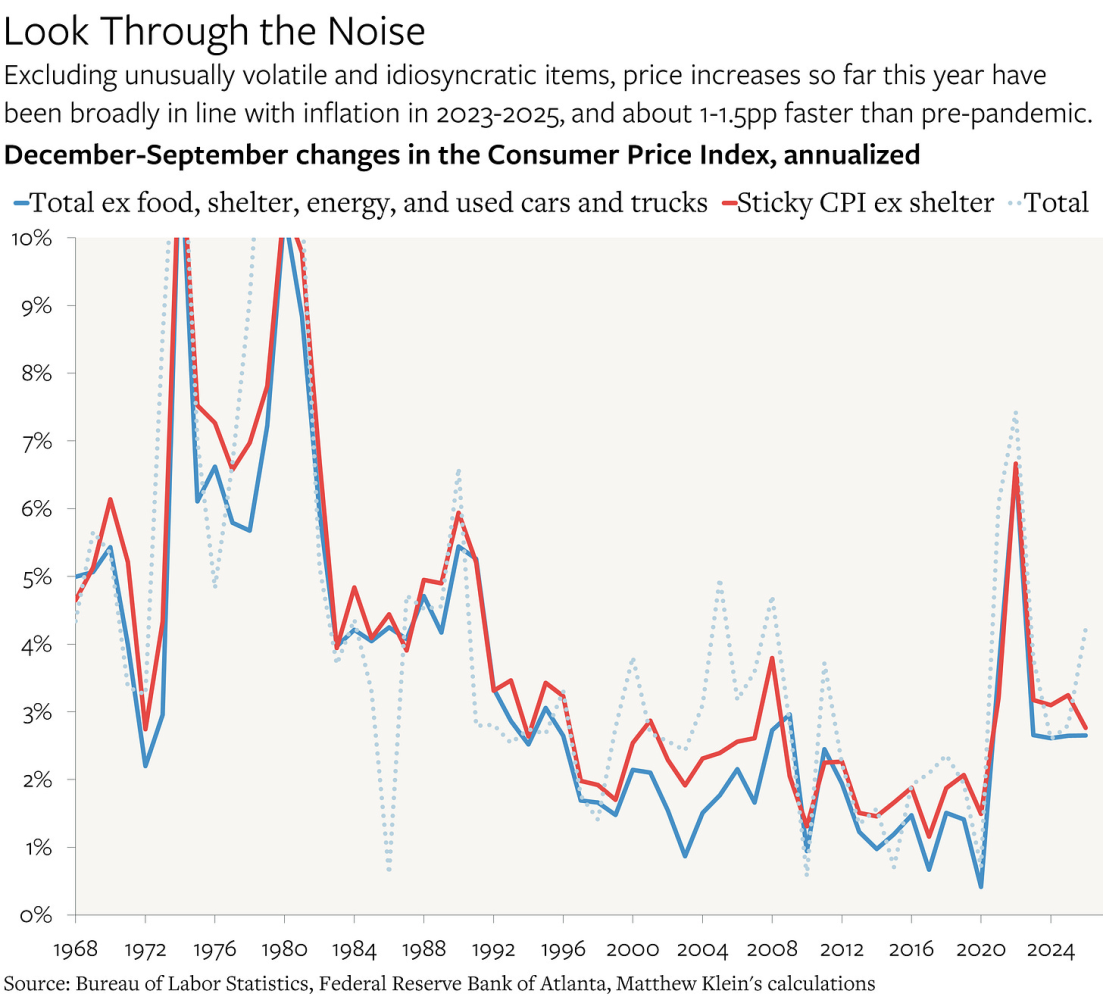
Inflation data released just this week came in hotter than the Fed will comfortably want to see going into a December meeting. AP News wrote ““It’s worrisome. There is a sense that inflation is broad, persistent, a little bit everywhere,” said Riccardo Trezzi, founder of Underlying Inflation, a consulting firm, and a former Fed economist. “The Fed should be very worried.” Using rough estimates for last October’s data, Trezzi calculates that consumer prices rose 4% in October from a year ago, up from 3.7% in September. Core prices rose 2.8%, he estimates, up from 2.6%.”
According to the Bureau of Labor Statistics, consumer prices increased 0.4% in October, down from the 0.6% increase in September. So there was some moderation in the headline number, but the underlying inflation picture isn't nearly as encouraging. Core CPI, which excludes food and energy, increased 0.3% for the third consecutive month. That's not the kind of sustained improvement I think the Fed needs to see to become comfortable that inflation is returning to its 2% target.
And when we look at what consumers are actually paying for, there are still plenty of reasons for concern. Food prices increased 0.5% in October, shelter costs rose 0.3%, and energy prices increased another 0.7%, although that was a significant slowdown from September's 5.2% increase. Shelter alone accounted for more than 30% of the overall monthly increase. So while the rate of inflation may have moderated slightly, households are still absorbing additional increases in some of their most essential expenses.
I think this is where the Fed finds itself in a particularly difficult position. Economic growth remains strong, unemployment is relatively low, and consumers are still spending. Meanwhile, underlying inflation hasn't shown much meaningful improvement. The latest report also came in hotter than economists expected, which only strengthens the argument for another interest rate increase in December.
So while the October report offered a little relief in the headline number, I don't think it fundamentally changes the inflation outlook. We're still dealing with persistent underlying price pressures, and that's before we consider the additional uncertainty surrounding energy costs and the conflict with Iran.
Last month, I spent quite a bit of time discussing the impact of elevated energy prices on inflation, and I don't think we need to revisit all of that again. But energy remains a major part of the inflation story, particularly because higher fuel costs don't stop at the gas pump. They work their way into the cost of manufacturing, transporting, and ultimately purchasing goods. According to Edward Jones, energy prices were up 21.3% year over year in September, contributing to headline PCE inflation reaching 3.6%. That's a significant amount of additional pressure on households already struggling with the cost of living.
There was, however, an interesting development following the election. According to Edward Jones' latest market commentary, crude oil prices fell more than 8% the day after the election as investors began pricing in a greater likelihood of a diplomatic resolution to the conflict with Iran. With Democrats gaining control of Congress, there is speculation that political pressure to end the conflict could increase, particularly if Congress becomes less willing to fund an extended military campaign. That would certainly be welcome news for inflation, consumers, and businesses alike. Lower energy prices could relieve some of the pressure on household budgets, transportation costs, and the broader economy.
But I'm not convinced we're anywhere close to knowing what a resolution would actually look like. Iran has expressed interest in collecting payments associated with oil shipments moving through the Strait of Hormuz, as well as receiving substantial financial compensation for damage sustained during the conflict. If either of those demands becomes part of a negotiated agreement, we could still be looking at additional costs associated with restoring energy flows, whether through higher transportation costs, government spending, or some combination of the two. And of course, we don't yet know what concessions, if any, the United States would ultimately agree to.
So while the market seems optimistic that the election could accelerate a resolution, I think there are still far more questions than answers. A diplomatic agreement could certainly bring oil prices down, but I don't think we can assume that getting back to where we were before the conflict began will be simple or inexpensive. Until we have a clearer understanding of how the conflict ends, what happens to energy supply, and who ultimately bears the costs of a resolution, energy remains one of the biggest inflationary wildcards heading into 2027.
So what is it actually going to take to get inflation back to 2%? I think that's the most important question we're facing as we head into 2027, and I'm not convinced there's a particularly painless answer.
Matthew Klein made an interesting argument in his recent inflation analysis. Even before tariffs, the war with Iran, and the surge in AI-related investment, underlying services inflation was running persistently above its pre-pandemic pace. In other words, we can't blame all of today's inflation on the latest external disruptions. Consumer demand has remained strong, and Klein points out that nominal retail sales are still growing around 7% annually, with restaurant and bar spending increasing closer to 9%. Those numbers certainly don't suggest consumers have stopped spending.
So how do we slow inflation when the economy continues to grow and consumers continue to spend? Higher interest rates are one option. By making borrowing more expensive, the Fed can discourage spending and investment, eventually reducing demand and the pressure on businesses to raise prices. Gregory Daco expects another quarter-point rate hike in December, and Edward Jones has suggested additional tightening may be necessary as well. But higher rates also mean more expensive mortgages, business financing, and consumer credit. We've already seen the impact on housing, and I think it's fair to question how much more pressure certain parts of the economy can absorb.
Another possibility is slower wage growth. Klein noted that wage growth across much of the private sector recently moderated from a little over 4% to around 3%, which could help bring underlying inflation down if that trend continues. (Note that 3% does not quite cover the inflationary costs of consumer goods increases YOY that I reported above, and trails by a little less than a percent.) And as we will discuss in the jobs section, productivity gains are allowing businesses to increase output without proportionately increasing labor costs. That's encouraging because it offers a potential path toward lower inflation without requiring widespread layoffs or a significant contraction in economic activity. But there's a catch. If wages continue growing more slowly than prices, households lose purchasing power, and eventually that can weaken the very consumer spending that has been supporting economic growth.
Of course, there's also the possibility that inflation eases through improvements in supply rather than weaker demand. Greater productivity, lower energy prices, fewer trade disruptions, and more efficient production could all help businesses manage costs without passing additional increases along to consumers. In my opinion, that would be the more favorable outcome. But as Orphe Divounguy pointed out, monetary policy can slow demand, but it cannot produce more oil, eliminate tariffs, or create additional workers. And we still don't know whether productivity gains will be large enough, or spread broadly enough, to offset those pressures.
I think the challenge is that we're asking the economy to accomplish several things at once: bring inflation back to 2%, maintain relatively low unemployment, preserve household purchasing power, and continue growing.
October’s jobs report exceeded expectations with some positive revisions to August and September’s data. This newsletter is being published later than usual because I was intentionally waiting for some important data releases that happened last week and this week. Jobs data being one of them.
I was particularly interested to see how wage growth held up in this release. Job growth is, in my opinion, less important right now than it has been in previous years due to the fact that the economy doesn't necessarily need to add as many jobs as it once did to maintain a healthy unemployment rate, particularly if labor-force growth has slowed. To put it clearly, Reuters reported this month that:
“Economists estimated the economy needs to create at least 40,000 jobs per month to keep up with growth in the working-age population. The so-called breakeven rate has declined from roughly 150,000 in 2024 because of the smaller labor force as the Trump administration cracks down on immigration.”
People have spent a lot of time discussing weak hiring this year, but I think the more important things to be watching are wage growth as it impacts inflation and consumer spending power, and productivity as it impacts the need for hiring. From a trucking perspective we also care about job growth specifically within freight generating sectors.
The October report showed the economy adding 165,000 jobs, unemployment falling to 4.1%, and average hourly earnings increasing 3.1% year over year. (Again by this measure, incomes are trailing inflation this month) So, on the surface, there are quite a few positives here. Job growth is comfortably above the estimated breakeven rate, unemployment remains relatively low, and wage growth continues to moderate without a major deterioration in employment.
And that last point is particularly important to me. I've spent a lot of time discussing how persistent wage growth can support consumer spending and make underlying inflation more difficult to control. But slower wage growth doesn't necessarily have to mean a weaker economy, particularly if productivity is improving and inflation begins to cool alongside it.
Gad Levanon published an excellent analysis following the release of four major economic reports: third-quarter GDP, the Employment Cost Index, productivity, and October employment. His conclusion is that the economy is performing well, but the relationship between economic growth, employment, and wages is changing.
According to Gad's analysis, over the past four quarters, output increased 2.7%, hours worked increased only 0.3%, and productivity increased 2.4%. In other words, the economy is producing considerably more without requiring a proportionate increase in labor hours. He also notes that productivity is now approximately 10% above its pre-pandemic trend, with much of the acceleration concentrated in technology-intensive industries.
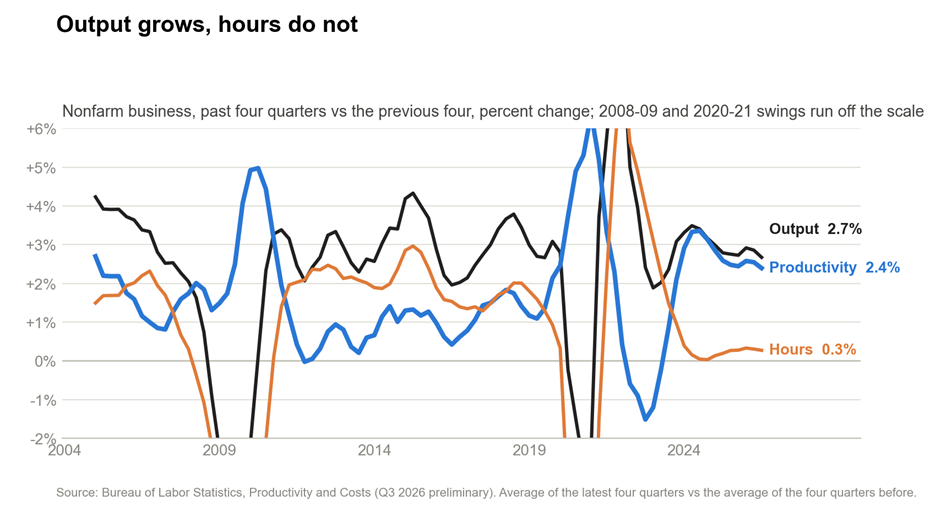
I think that's a pretty remarkable development, and it helps explain why we can have relatively modest hiring alongside continued economic growth. It also raises an interesting question about how we should interpret employment data going forward. If businesses can continue increasing output without adding nearly as many workers, what does healthy job growth actually look like?
But there is another side to this productivity story that I think deserves attention. Gad points out that productivity has increased approximately 16% since the end of 2019, while real hourly compensation has increased only about 7%. He also notes that wage growth, measured by the Employment Cost Index, has converged near 3% across both management and professional employees and other workers.
So businesses are becoming more productive, but workers aren't necessarily seeing those productivity gains translate proportionately into their paychecks. That's potentially helpful from an inflation standpoint because labor costs are growing more slowly relative to output, but it also means household purchasing power may not be keeping pace with the broader economy's growth.
Now, from a freight perspective, there's another important distinction to make: not all job growth is equally meaningful for truckload demand.
Gad notes that healthcare and social assistance have accounted for nearly 60% of employment growth over the past year. Those jobs certainly support household incomes and consumer spending, but they don't generate the same direct demand for truck transportation as manufacturing, construction, or goods-producing industries.
Reuters also noted a continued decline in residential construction jobs, an industry strongly related to domestic freight movements. “Construction shed 3,000 jobs, the bulk of them residential specialty trade contractors. Residential building construction employment also declined against the backdrop of high mortgage rates, which have depressed homebuilding. Home renovations have also been trending down.”
Which brings me to something Jason Miller pointed out in his analysis of October's manufacturing employment data.
Manufacturing employment increased in October, which is encouraging, but Jason found that the gains were concentrated entirely within durable goods manufacturing, particularly primary metals, fabricated metal products, machinery, and computers and electronic products. These are all industries that stand to benefit from the enormous amount of capital investment supporting AI infrastructure.
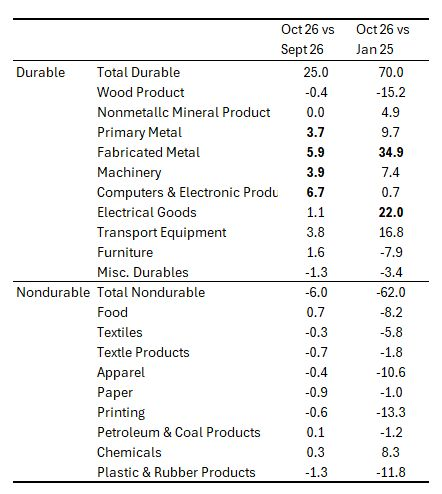
Jason also notes that manufacturing employment is up only about 8,000 jobs compared with January 2025, and preliminary benchmark revisions suggest that figure could ultimately be revised lower.
And I think that brings us back to a concern I've already raised in this report. AI investment is supporting an increasingly significant portion of economic growth, productivity improvements, construction activity, and now employment gains within certain manufacturing industries. But what happens if that investment slows?
It's an important question for the broader economy, but especially for those of us watching freight demand. Manufacturing growth driven by a handful of capital-intensive industries is not necessarily the same thing as a broad-based recovery in freight-generating activity.
So let's take a closer look at what is happening within the manufacturing sector.
October's ISM Manufacturing PMI came in at 55.5, up from 54.5 in September, marking the tenth consecutive month of expansion for the manufacturing sector. New orders increased slightly to 55.5, while production climbed to 59.0, its highest reading since November 2021. Employment remained in expansion territory at 52.4, although growth slowed slightly from September. Overall, these are encouraging numbers, particularly for an industry that spent much of the previous few years struggling to find consistent momentum. ISM Manufacturing PMI
But one of the things I said last month that I wanted to keep watching was input costs, and I'm still concerned about what we're seeing. The ISM Prices Index declined from 77.9 in September to 75.2 in October, which means prices are increasing at a slightly slower pace, but they're still increasing significantly. In fact, ISM reported that no manufacturing industries experienced declining raw-material prices in October. Diesel fuel, freight, steel, aluminum, copper, electronic components, and semiconductors were all among the commodities reported as increasing in price. Supplier deliveries also continued slowing, and customer inventories remained too low. So while demand and production are improving, manufacturers are still facing substantial cost pressures.
And as we discussed in the employment section, that growth isn't necessarily evenly distributed. Gad Levanon's industrial production research highlights how advanced manufacturing industries, including computers and electronics, machinery, chemicals, and transportation equipment, have been outperforming much of the broader sector. October's ISM report supports that distinction, with five of the six largest manufacturing industries reporting growth. I think the question heading into 2027 is whether this momentum can broaden beyond the industries benefiting most directly from capital investment, and whether manufacturers can continue expanding production without passing along additional price increases. Also a concern, is if the AI investment or progress slows, how much will manufacturing activity slow with it?
Moving on to GDP, the economy continues to demonstrate some impressive resilience. According to the Bureau of Economic Analysis, real GDP grew at an annualized rate of 3.4% in the third quarter, accelerating from 2.2% in the second quarter. Consumer spending, business investment, and government spending all contributed to growth. Considering the elevated interest rates, energy costs, and inflation we've been discussing, I think there's a lot to be encouraged by in that number. But the question now is how sustainable that growth will be heading into 2027.
David Kelly of J.P. Morgan Asset Management recently published an outlook suggesting that economic growth could moderate to 2.4% in the fourth quarter and fall below 2% in 2027. One of his biggest concerns is consumer spending. He estimates that spending grew 3.4% in the third quarter, supported by tax refunds, stock market gains, and World Cup-related activity, but expects growth to slow to 2.2% in the fourth quarter and below 2% next year. His reasoning is consistent with much of what we've already discussed: wage growth has been trailing inflation, hiring has slowed, and households may have less room to continue increasing spending. Housing construction is also expected to remain weak under the pressure of elevated mortgage rates and affordability challenges.
Business investment, particularly in AI infrastructure, is expected to remain a source of growth, although Kelly anticipates that investment growth will moderate from 7.3% in 2026 to 5.6% in 2027 as financing costs, supply constraints, and political opposition create additional challenges. And as Matthew Klein's research also highlights, a substantial portion of AI investment relies on imported chips and equipment, meaning not all of that spending translates into domestic production or U.S. freight demand. So while I'm encouraged by the strength of the economy today, I think we need to be realistic about the possibility of slower growth next year. A strong GDP report doesn't necessarily mean freight demand is growing at the same pace, particularly when so much of the growth is concentrated in services, technology, and capital investment. That distinction is important as we turn to the latest truckload market data and evaluate elevated rates that are still the result of a supply driven market flip.
Our monthly rate charts are updated and supplied by the analytics team at DAT. If you have questions about the charts, Dean Croke would be a great person to connect with!
October freight market summary
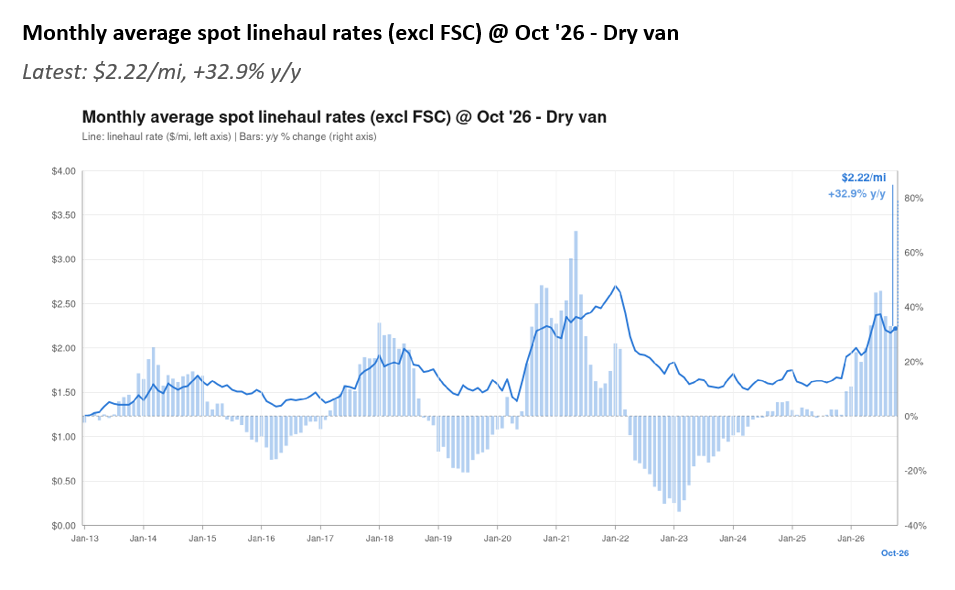
October was tight on capacity on DATs load board, not a hot freight market. Dry van truck posts finished the month 26.1% below a year ago, so the load-to-truck ratio sat at 10.93 on Oct. 31 against 6.37 a year earlier. Load posts were up y/y in all five weekly readings, from 16.9% to 32.7%, so freight was there.
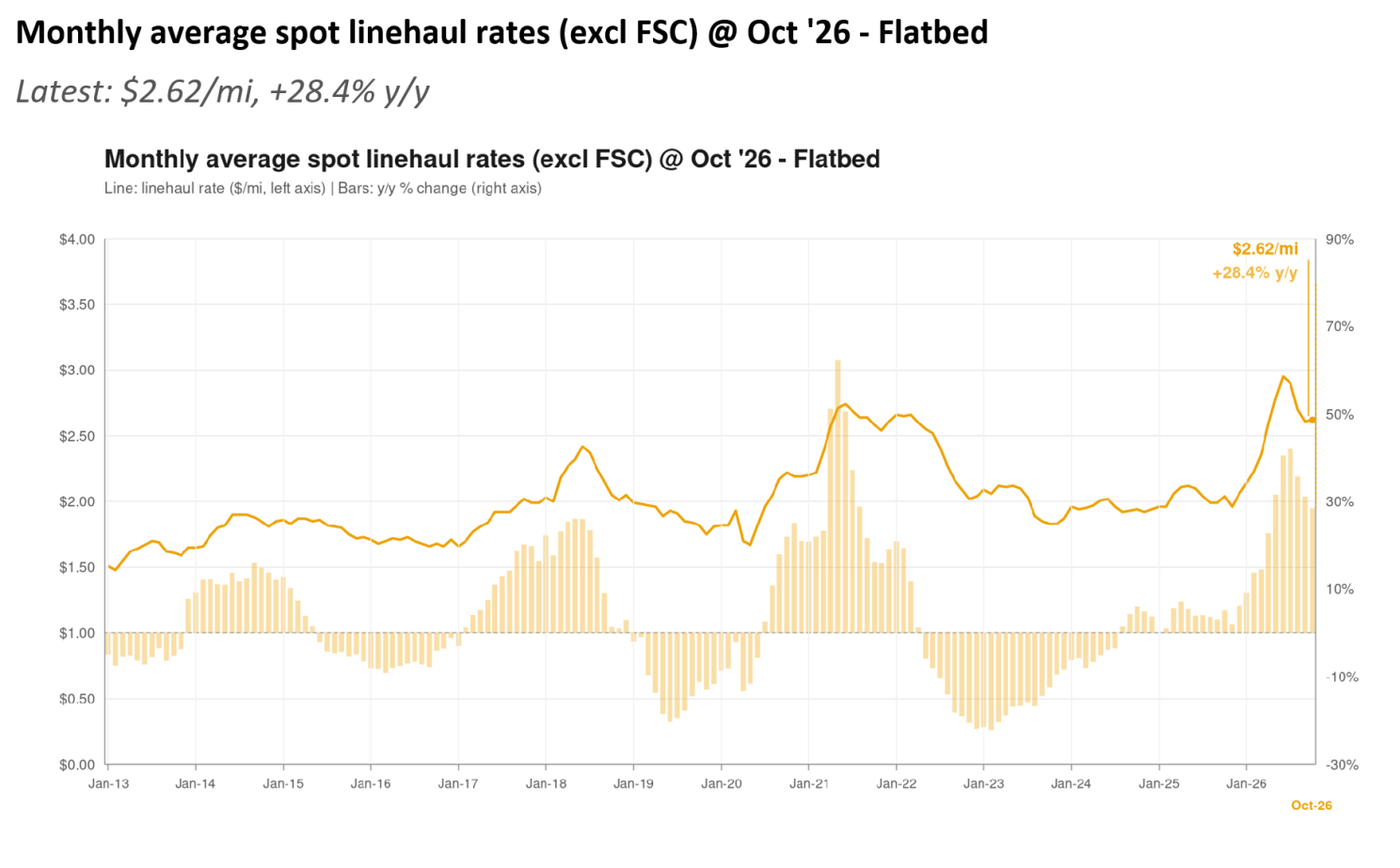
Demand was lumpy, though. Quarter-end lifted dry van load posts 17.5% w/w in the week ending Oct. 3, then load posts dropped 20.4% in dry van, 20.7% in reefer, and 12.5% in flatbed the next week. Reefer load posts slid to 4.4% below last year in the week ending Oct. 24 before rebounding to 11.3% above in the final week. Flatbed stayed the tightest board at 41.73 loads per truck, 3.8 times dry van's, and its spot rate ended the month above the top of the nine-year seasonal range.
After surging by $0.70/gal in September, diesel was only up $0.04/gal in October providing some relief for carriers. Still, over-the-road diesel ended October at $6.42/gal, up 48% ($2.05/gal) higher than the pre-war baseline of $4.30/gal. Fuel is now 43% of a spot dry van carrier's operating costs vs 32% before.
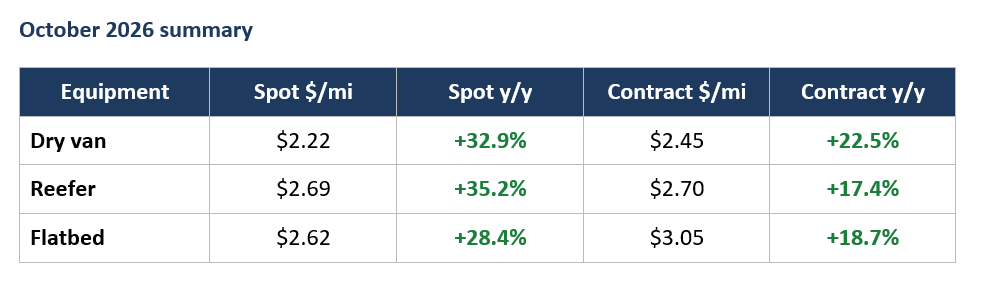
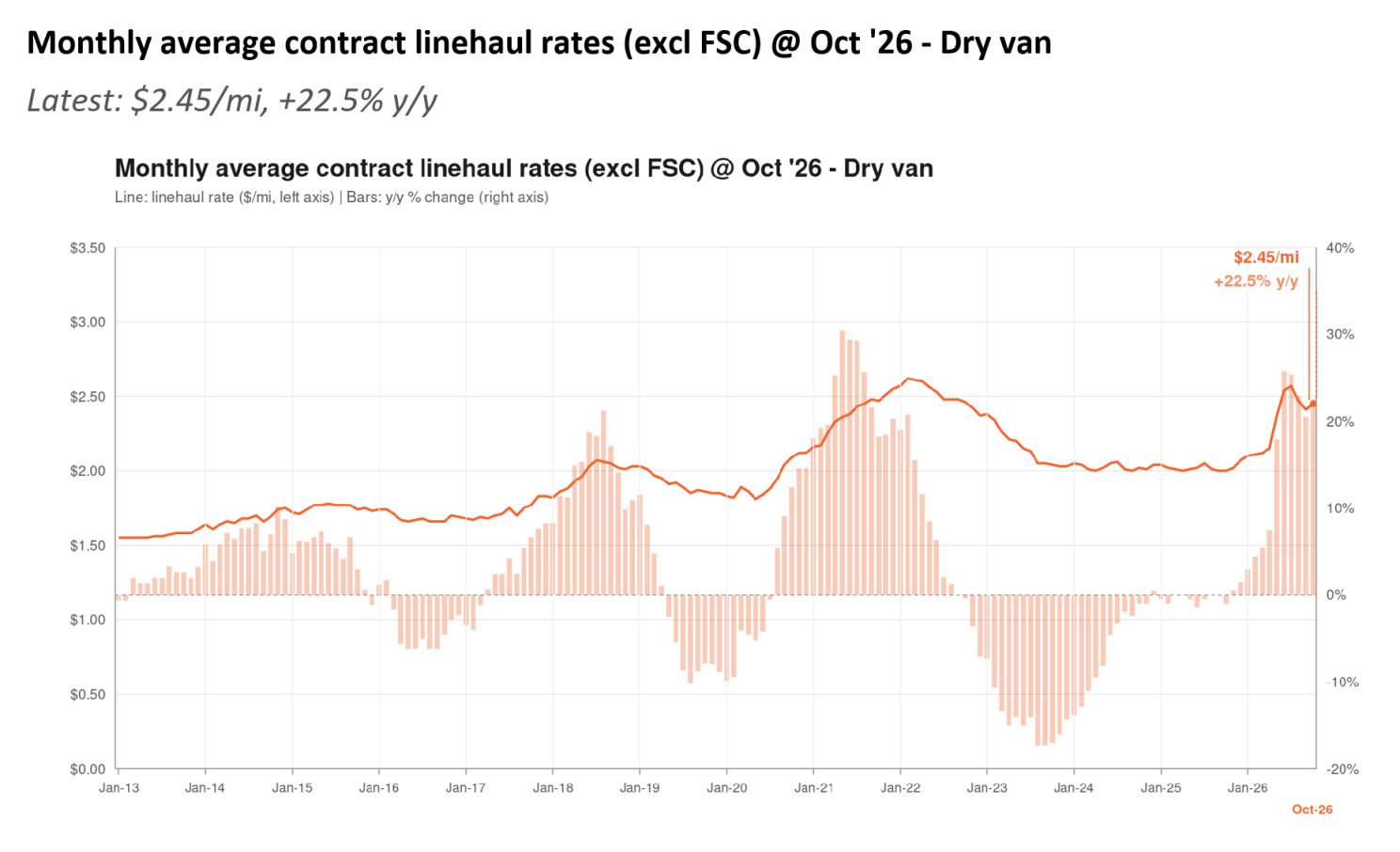
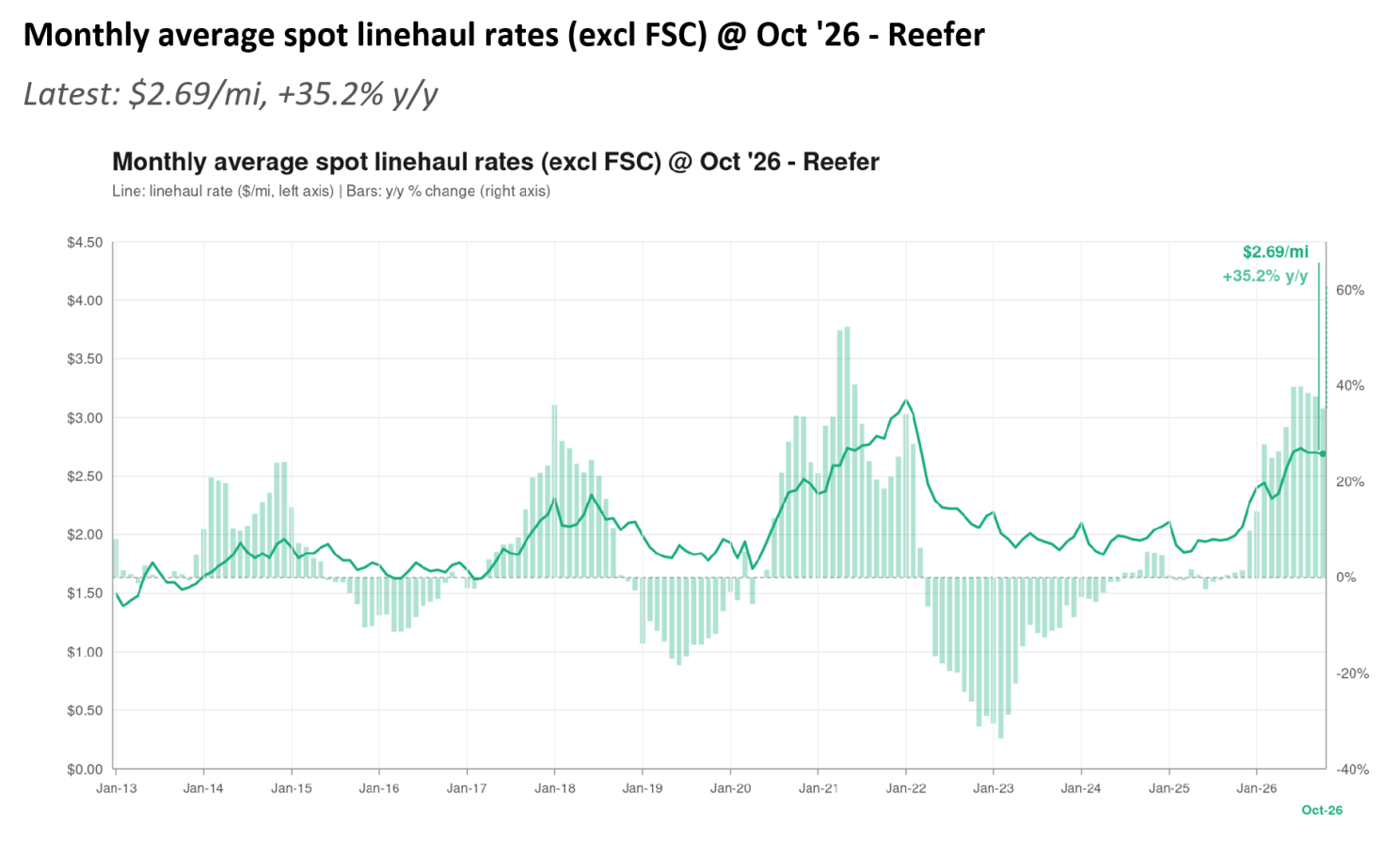
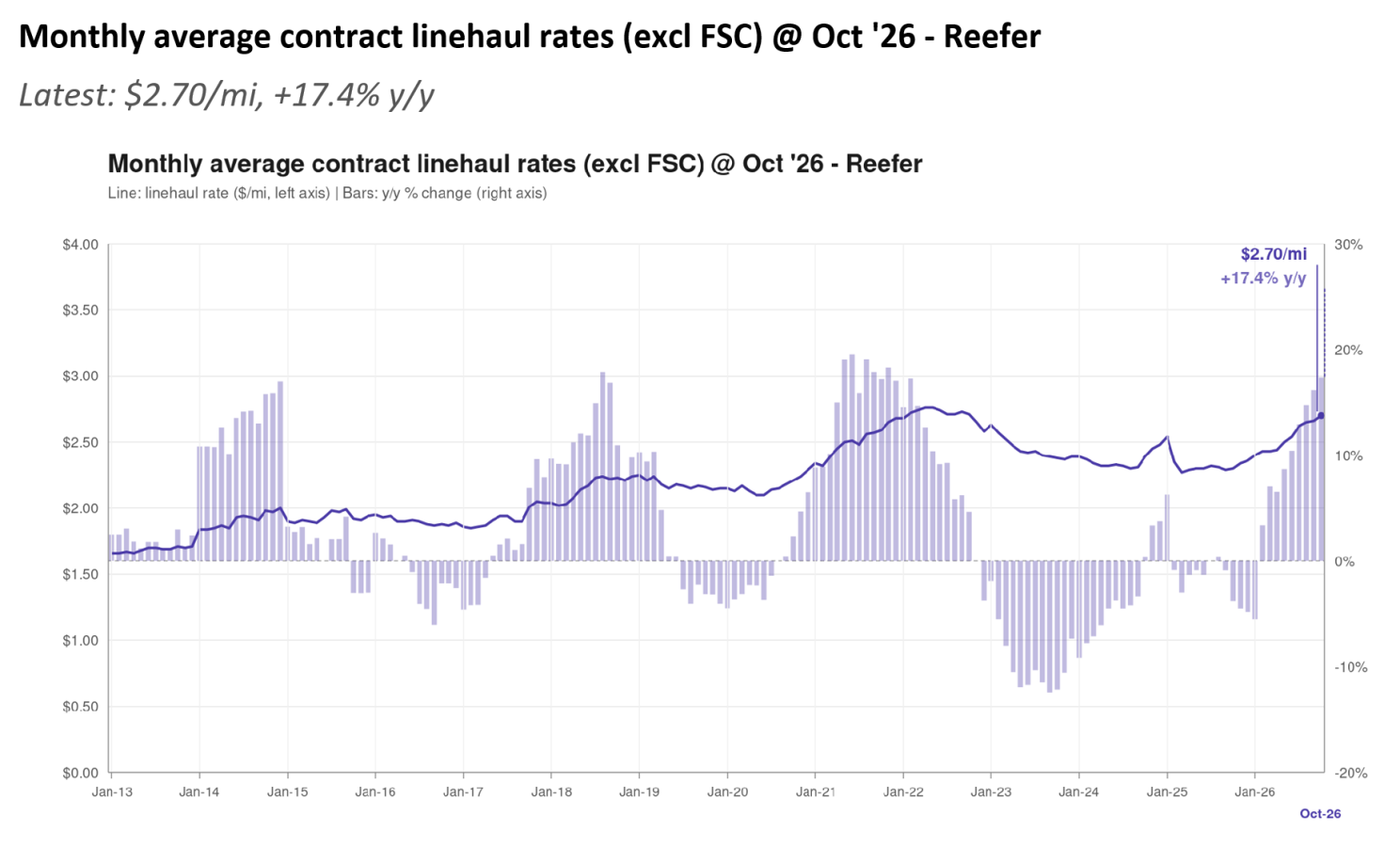
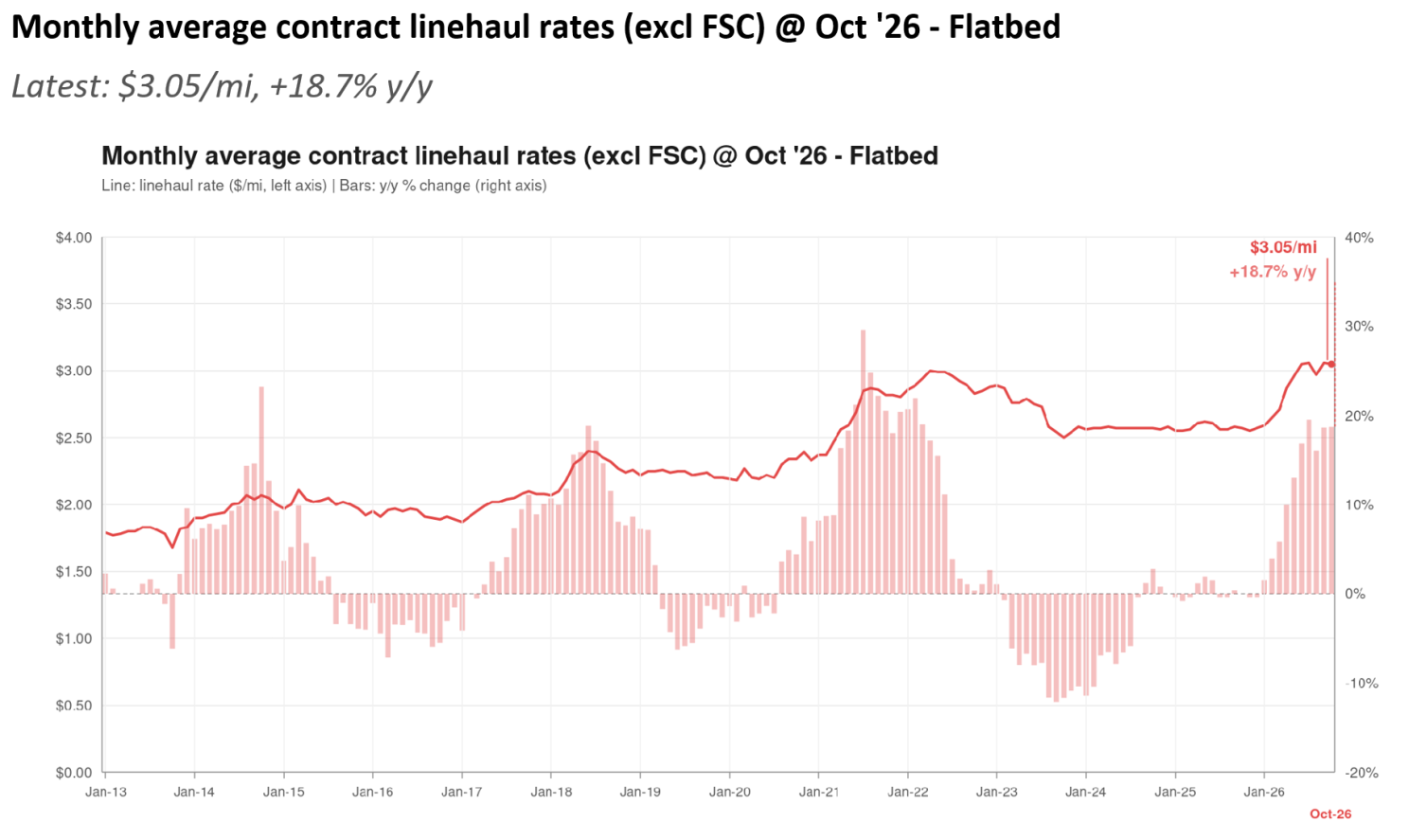
The y/y gains look big because last October's base was weak. Dry van spot averaged $1.67/mile in October 2025 and reefer spot $1.99/mile, so this year's $2.22/mile and $2.69/mile read as +32.9% and +35.2%. Contract y/y is smaller, +17.4% to +22.5%, against a firmer base.
The m/m move is much quieter. Dry van spot added $0.05/mile from September, flatbed spot added $0.01/mile, and reefer spot slipped $0.01/mile. Reefer spot ($2.69/mile) now sits $0.01/mile under reefer contract ($2.70/mile).
Rates are linehaul only, excluding fuel surcharges. Contract values in the workbook have not been reconciled against the RateView benchmark for this run.
Meet Me For Coffee with Samantha Jones seeks to correlate macro-economics to freight markets (just like this Newsletter does) and offers a chance to hear various industry and non-industry experts explain their thoughts on economics and freight markets.
Check out our Podcast Channels on your preferred platforms!

Have you heard of Manifest? Manifest Vegas: The Future of Supply Chain in Las Vegas?
If not, it’s one of supply chain’s largest and fastest growing industry conferences in the world. Held every year in Las Vegas at the Venetian, Manifest now attracts over 8,500 attendees from over 60 countries.
Who attends? Over 2,000 shippers show up, with members of teams from across their organization. Over 1,500 startups and investors attend, and thousands of technology companies, logistics providers, and more.
Interested in learning more to see if it’s for you?
Check out their website, or listen to our Recent Podcast with Katie Date, the SVP of Industry Relations and Strategic Initiatives at Manifest that answers all your questions around should you attend, and if you are how to make the most of the investment.
Did you know Shippers have special rates to attend? Reach out to me or the Manifest team directly to get connected with the shipper registration team.
And, to save $200 on your registration for everyone else, all you have to do is register here: LINK TO REGISTER AND SAVE $200

Thank you so much for reading and supporting the Truckload Market Update Report, produced by Samantha Jones Consulting LLC. Samantha Jones Consulting focuses on helping companies in the logistics industry better brand and sell their services to create sustainable revenue growth, and support their company growth goals!
We love Feedback, if you have questions, comments, suggestions, or are interested in sponsorships or partnerships, please email samantha@connectsjc.com to connect!
Make sure you subscribe to the Newsletter to receive the monthly update, and please share this with a friend who can also benefit from reading! As always, Samantha's work is free and created with the intent to add value to the transportation industry.
