

The next Federal Reserve interest rate decision and press conference is on Wednesday, September 16. We have not seen a rate hike since July 2023. The probability of a rate hike is now about 60%, according to CME FedWatch.
Moody’s Analytics estimates that the top 20% of earners generated nearly all US spending growth over the last three years, and that’s the same demographic that has benefitted from booming stock prices. The folks in the top 10% of the income distribution account for 90% of the equity holdings.
The growth in the stock market has been heavily driven by AI.
Here’s where I am going with this: AI growth and valuations have made the US stock market boom, this boom has made the rich richer, and the rich have spent money in the face of rising inflation, propping up many US economic data points that we measure to gauge the health of the economy and freight demand. The labor market has held up, and inflation has refused to fall below 3%. That’s where we sit today.
The K-shaped economy has continued, and we now have two extremes happening simultaneously in the market. The upper half of the K is doing great, largely dependent on the continued high valuations of AI companies, and the lower half of the K is struggling to make ends meet. I want to explore these two halves better through a few measurable data points.
For much of the past few years, I have watched wage growth closely as one of the key pieces of the inflation puzzle. The concern was straightforward: when wages are rising rapidly, businesses face higher labor costs, consumers have more income to spend, and higher prices can feed back into demands for higher pay. We needed wage growth to cool before we could confidently say that cycle had been broken. Many are saying we are there now. Wage growth slowed to 3.1% in August, while unit labor costs increased at only a 1.2% annualized rate in the second quarter. As David Kelly at J.P. Morgan Asset Management points out, without higher prices flowing through into higher compensation, it becomes very difficult to generate the kind of price-wage spiral policymakers spent the last several years worrying about. There is now little evidence that the labor market itself is creating meaningful inflationary pressure. David Kelly also wrote that,
“Anemic job and wage growth will continue to suppress the demand for houses, light vehicles and a host of other consumer goods and services, particularly after the stimulus effects of income tax refunds and tariff refunds have faded. Very slow job growth probably makes the economy somewhat more vulnerable to recession also."
That matters for us in freight markets. Even with the top percent of earners spending, a goods market would be much stronger with all earners spending.
But here is where I am struggling with the narrative. Another economist that I respect for the in depth reporting work he does, argued recently that wage growth has not slown down meaningfully. We have to dig deeper into the data and pull out some outliers to get the full picture. In one of Matthew Klein 's recent publications he said:
“While changes in worker pay are not inherently inflationary or deflationary, most of the financing for purchases of consumer goods and services comes from workers’ paychecks (or from government benefits that are indexed to the value of those paychecks). As long as the dollar value of hourly pay continues to rise faster than it did in the years before the pandemic, prices will also tend to rise faster than they did before the pandemic.3 The main mitigating factors are the extent to which additional income is saved rather than spent on goods and services, and the extent to which businesses in the aggregate can ramp up their production in response to higher prices. As I have been pointing out since the spring, the apparent deceleration in the typical worker’s average hourly pay gains is almost entirely attributable to extremely unusual developments in the “health care and private education” sector. Exclude those workers, and there has been no slowdown at all. That happens to track the underlying inflation data better than broader measures of wages.”
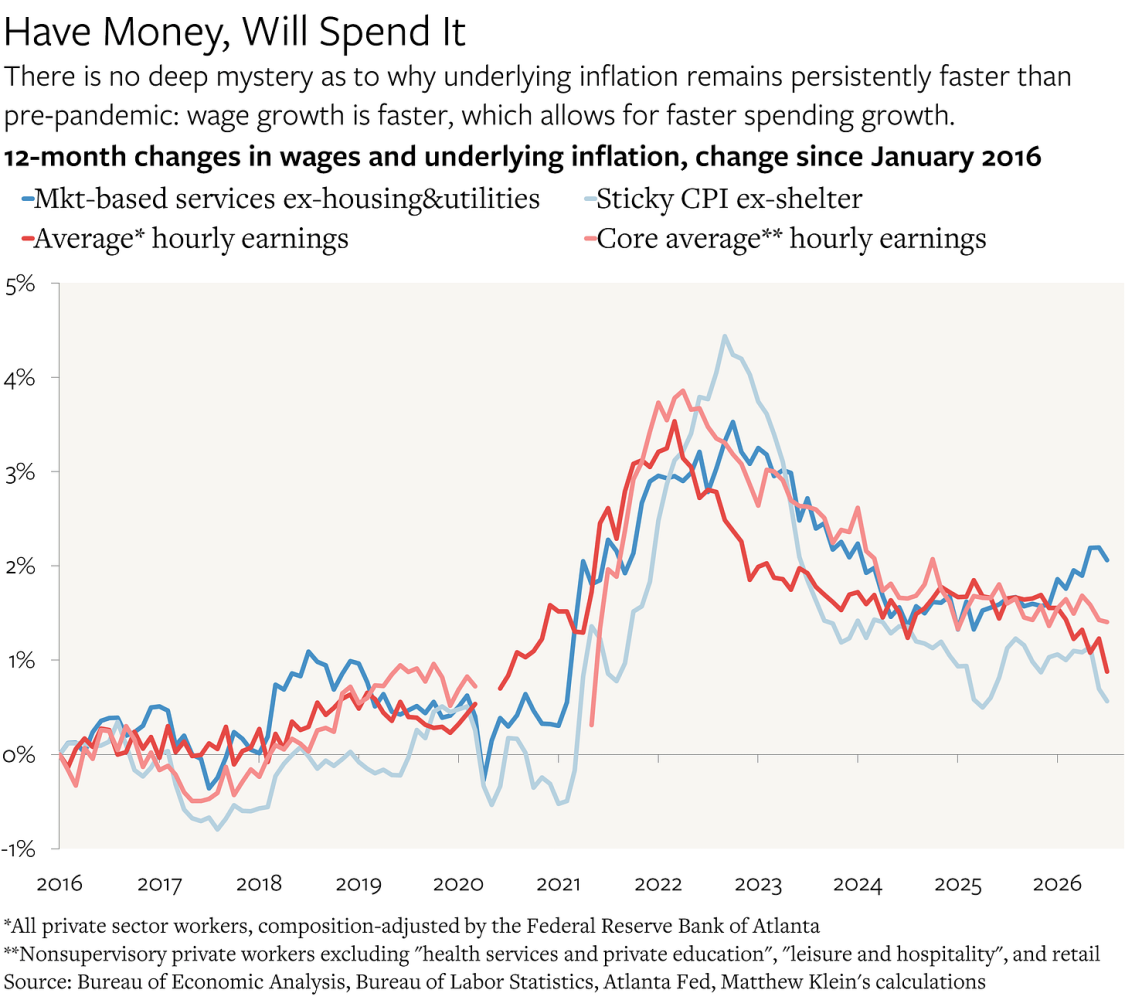
By his thinking, wages are still supporting consumer spending, but they are likely not creating the same inflationary pressure they once were because those dollars simply do not stretch as far. With fuel, energy and other household costs rising, consumers are spending more simply to cover the same basic expenses. In other words, higher spending does not necessarily mean the average consumer is buying more.
Outside of the highest-income households, I believe much of the increase in consumer spending is increasingly driven by necessity. The average household is spending more each month to cover bills and everyday expenses, while real disposable income has essentially gone sideways and has actually declined for households in the bottom half of the income distribution. Wages remain elevated compared with pre-pandemic norms, but wage growth has been cooling, reaching 3.1% in August. That makes upward wage pressure much less concerning as a driver of inflation today. Consumers may still be spending more dollars, but increasingly, they are doing so because those dollars buy less.
The most recent jobs data also told us that employers added 162,000 jobs in August, June and July were revised higher by a combined 55,000, and year-to-date job creation remains roughly in line with last year. Unemployment is still only 4.1%, and layoffs remain relatively low. The weakness is showing up instead in how difficult it has become to find a new job once someone loses one: the number of long-term unemployed rose to 1.9 million and median unemployment duration climbed to 11.4 weeks from 9.9 weeks a year ago. That makes this look less like a labor market suddenly cracking and more like one that has become increasingly stagnant.
For inflation, however, the important takeaway is that wages have cooled. The inflation battle is not primarily a wage battle. The remaining pressures increasingly need to be evaluated elsewhere, particularly among the supply-side forces that monetary policy has much less ability to control.
According to analysis cited from the San Francisco Fed, only about 41% of headline inflation over the past year was clearly demand-driven. Some of the pressures keeping prices elevated are instead coming from supply-side forces, including tariffs and higher energy costs tied to the renewed Middle East conflict. The Fed can weaken consumer and business demand with higher rates, but it cannot produce more oil or remove a tariff.
Zillow’s economist Orphe Divounguy made the case that the Fed does not want to make a mistake by raising interest rates in an effort to control inflation that is not primarily driven by demand forces at this point in time. And I tend to agree with this line of thinking. The Fed has a single blunt instrument for controlling inflation: interest rates. And raising or lowering interest rates cannot at this point in time effectively curb the sources of inflation without unnecessarily hurting the average American worker or household. And remember, the average American worker is not even part of the inflation problem at this point in time (not major earners from stock booms or major spenders, and many are no longer seeing massive wage gains or even wage gains that keep up with the price of fuel and monthly expenses). Orphe wrote:
“And look at the economy Warsh is leaving the door open to tightening into. Real GDP grew just 1.5% in Q2, and equipment plus intellectual-property investment contributed 1.2 percentage points of that growth. Homebuilding is having its weakest summer since 2020. And the latest BLS benchmark revisions say private payrolls were 178,000 lower than previously thought through March. That is not broad strength. And in Warsh's own words, inflation expectations remain well anchored. People still believe inflation will come down. The case for vigilance is strong. The case for urgency is weaker. Warsh himself says the AI buildout could raise future productivity — and with population and labor-force growth slowing, we need that payoff. The buildout is underway. The payoff isn't here yet. The Fed risks breaking the weak parts of the economy — and choking off the investment before the productivity shows up.”
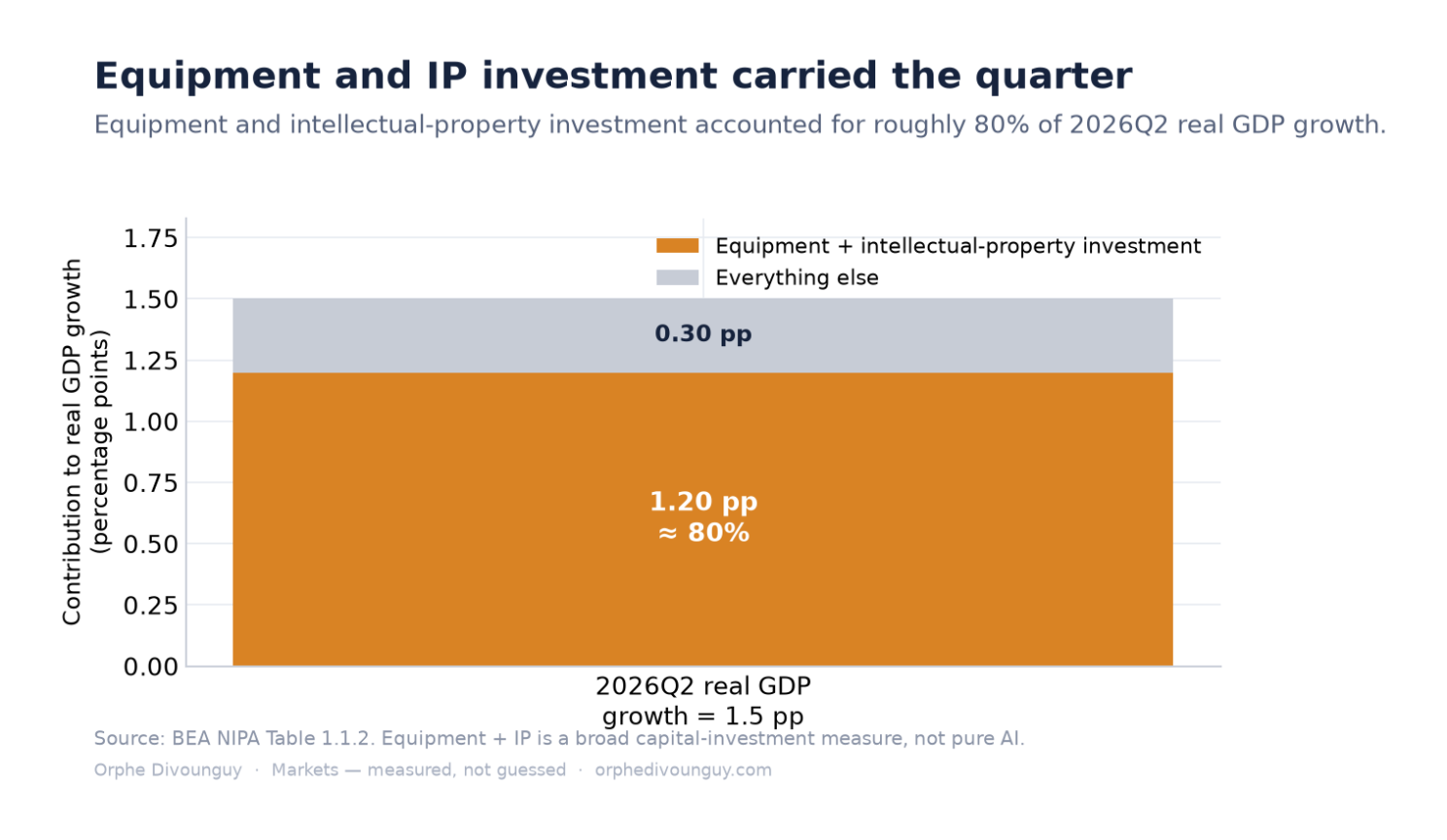
If you are interested, I highly recommend reading one of Orphe’s recent publications that better explains how much our economy is hoping the AI investment results in increased productivity. And why the sectors of the US economy that are booming are sectors that would not respond easily to small rate hikes, but US consumers would face the brunt of those increases instead. Read it here.
In my research this month, I came across a particularly interesting interview with Mark Zandi, Chief Economist at Moody’s Analytics, that aired on July 24. I thought Mark did an excellent job of putting the current economic environment into terms that are easy to understand, particularly the increasingly difficult position of the average U.S. consumer. His comments also highlight how close many households may be to a tipping point if inflationary pressures intensify or interest rates move higher.
They're much more at risk for the higher rates of inflation, rising cost of living, the Iran war, and the impact that's having on gas and grocery prices. And so, if you look at real after-tax income, so real disposable income…this is data from the Bureau of Economic Analysis through the month of May…it's gone sideways. It's zero to slightly negative over the past couple of months, and I don't think that's going to change. And that's kind of across the board. So that's on average, kind of in the middle of the distribution of consumers. So that means folks in the bottom half of the distribution are now experiencing outright declines in real after-tax income. It feels like this is going to make it worse because the Iran war has started up again. Oil prices are back up to $90 a barrel, close to. Gas prices are moving north, I think I just heard we're now back over $4 a gallon for regular unleaded, and so that's going to do some real damage. Real incomes are going to likely start to fall here if things don't change quickly in the Middle East. The thing is that saving rates are very low. Now, part of that is the wealth effect. I mean, high income net worth households are saving less because they don't need to save, because their nest egg is now much larger, but I also think it reflects the fact that lower middle income households have drawn down their savings to try to maintain their spending in the face of these very weak income numbers. So I think low and middle income households are in a very tenuous situation. The other thing I'd point out is higher interest rates. So interest rates are up. Of course, the Federal Reserve, before the war, we all thought the Fed would be cutting interest rates this year. Now the thinking is, if anything, they'll be raising interest rates. And of course, long-term interest rates have risen. The 10-year Treasury yield before the war was below 4%. Now I just looked today; it's 4.6%. Fixed mortgage rates have risen consistently with that. We were below 6% on a 30-year fix at the start of the war. We're now at 6.6, 6.7%. And the higher rate does damage to that lower middle income group in lots of different ways. If you have credit card debt, that's tied directly to the funds rate, so your credit card interest payments are going to rise. You have a home equity line of credit, that's tied directly to the federal funds rate, you're going to be paying more. If you're a small business person and you get a loan from a bank that's tied to the prime rate, which is directly tied to the federal funds rate. And of course, fixed mortgage rates go a long way to impacting refinancing activity, and home sales and home buying. So that's also going to do a lot of damage. So yeah, I think the low and middle income households are already quite vulnerable, even before the war started up again. Now, with the war kind of back in full swing, this could become a real problem for that group and thus the broader economy pretty quickly.
As far as the Fed’s ability to control inflation and the work they need to remain focused on, it’s still too early to declare victory, but there have been encouraging signs that inflation is at least holding steady. Core PCE increased 0.2% month over month in July, and roughly half of that increase came from imputed financial-services prices associated with fees paid to traders, something tied more closely to the booming stock market than to prices consumers are directly paying for everyday goods and services. Inflation remains above the Fed's 2% target, but the composition of that inflation increasingly matters when deciding whether another rate hike would actually solve the problem.
My takeaway: inflation is still the problem, but we need to be much more specific about which components of inflation we are fighting. Wage-driven inflation has cooled. What remains appears increasingly influenced by supply shocks, energy, tariffs, asset-market effects and pockets of strong demand. And if consumer spending is still contributing to hot inflation, it’s also worth noting that the consumers doing most of the spending are the top demographic experiencing hot gains in their asset portfolios. The Fed's job is particularly difficult because another rate hike could further weaken housing, hiring and household budgets without doing much to address the sources currently keeping prices elevated. Hurting the majority of households even more.
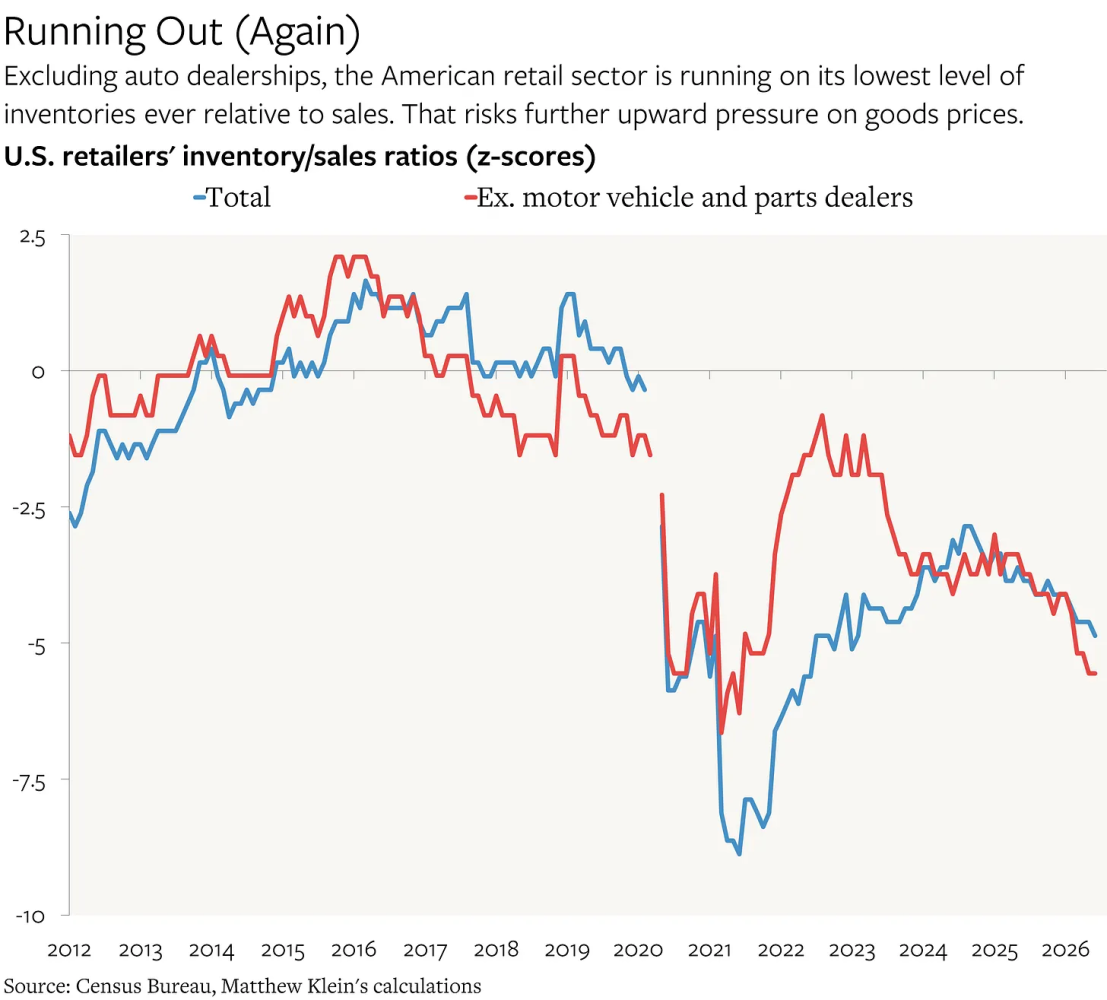
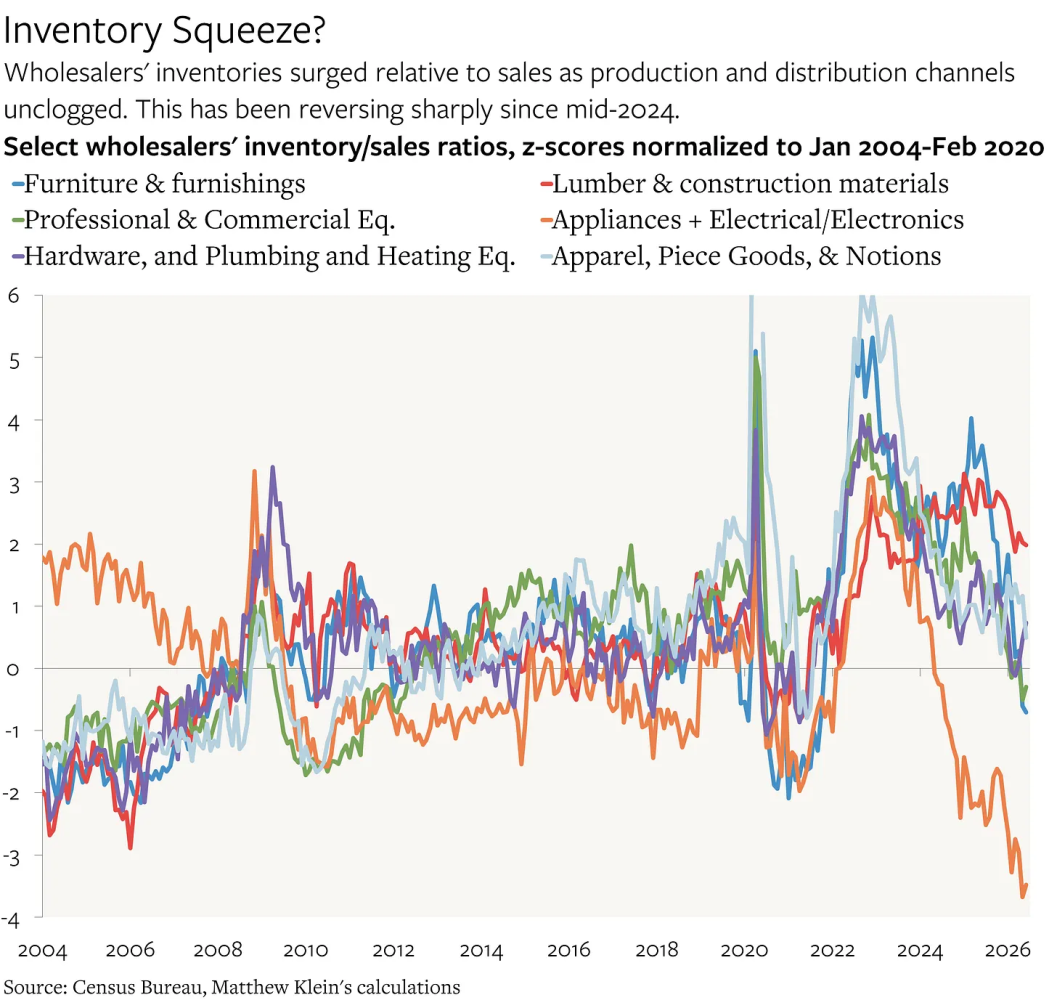
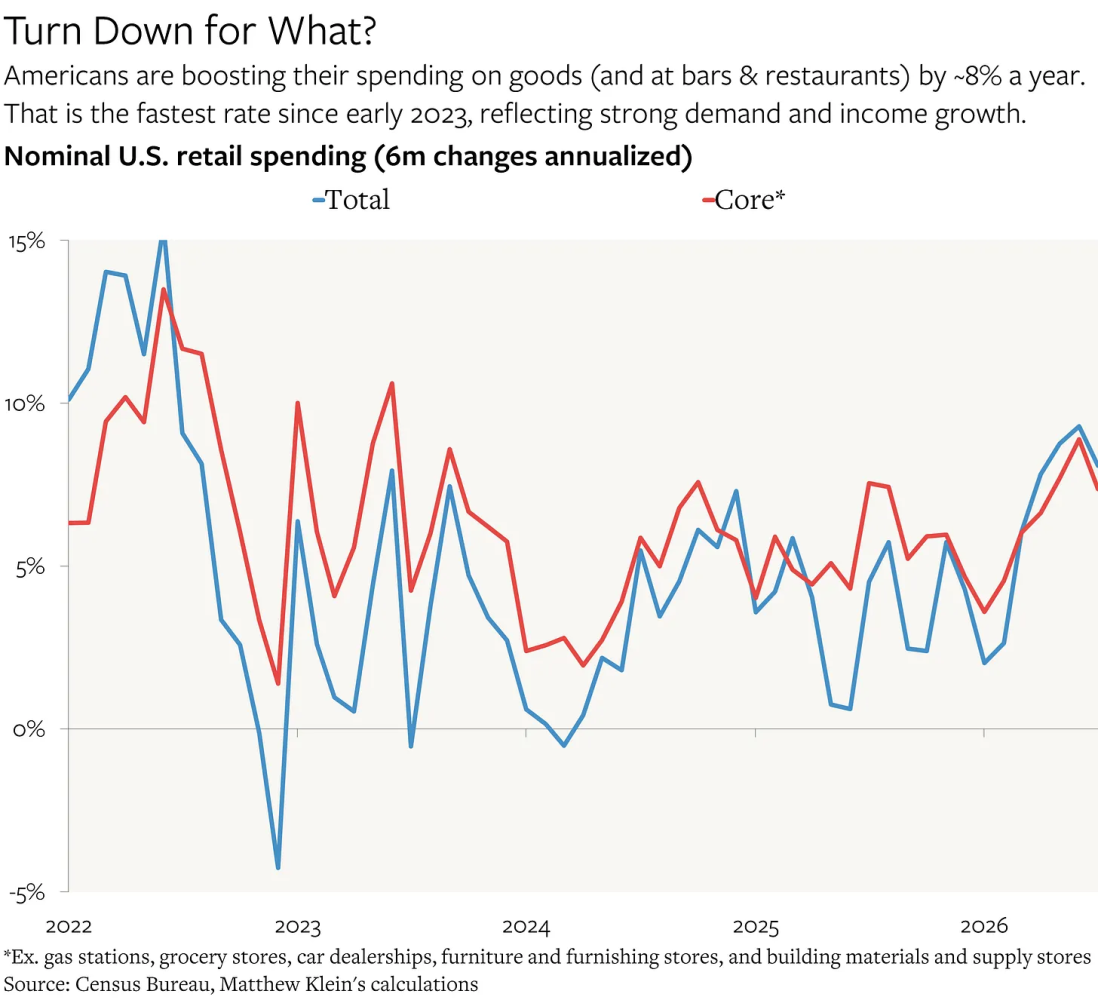
I remember during the pandemic inventories to sales ratios was something we monitored regularly to understand what sectors would be working on restocking efforts and which had overstocked. When things first began to cool off in mid 2022, we could see a clear connection between elevated inventories and reduced freight movements as inventory had to be worked through retail and wholesale channels before new orders could be placed. It would appear that retailers and wholesalers have not had an appetite to over inventory themselves again since. They have continued to let inventories get drawn down over the last several years. If I had to guess, the recent momentum we have felt has not been enough in the face of so much uncertainty to allow corporations to jump into optimistic ordering and inventory holding patterns again. They remain cautious. While this approach might be for the best, as Matthew Klein put it
"it still creates the risk of shortages and higher prices ahead if they are forced to restock on short notice. This is in the context of retail spending rising about 8% a year in dollar terms.”
For freight markets, low inventories are a good sign. If demand increases or even holds steady, new orders will have to be placed to eventually start rebuilding or maintaining inventories. This bodes well for US manufacturing, which freight markets care most about. I’ve included Matthew’s chart around the 8% spending increase, and while I cannot argue with the number, I would ask that we put it in the context of the upper 20% of incomes being the ones responsible for bolstering that spending.
Interestingly enough, even though inflation odds went up to 60%, many economists seem to believe a hold is much more likely. A recent publication by Gregory Daco provided me with an excellent wrap up to this month’s economics section. Too good to pass up:
“Given expected inflation and employment trends, we maintain our view that the Fed stays on hold through year-end. Our base case remains that the Fed stays on hold through year-end. In our view, the monthly print of core PCE was right on the cusp of the rate hike bar, meaning more patient policymakers will favor holding policy constant and waiting for more data, while the most hurried will favor tightening monetary policy. We won’t get another print for PCE inflation before the next FOMC meeting in mid-September, but two factors will play a role in deliberations. The August CPI print, which will likely translate into another “tolerable” 0.2% m/m advance in core PCE, and the expected 0.2pt downward revision to core PCE inflation from the Bureau of Economic Analysis (BEA)’s scheduled methodological changes to key PCE inflation components. In general, we do not believe rate hikes would be the optimal policy prescription for inflation driven primarily by supply shocks, including tariffs and the Middle East conflict. AI-related price pressures are undeniable and likely still in their early stages, but it is far from clear that a 25bp hike would do much beyond further damaging already-constrained interest-sensitive sectors while doing little to curb the AI-led investment surge. With inflation expectations firmly anchored, an objective cost-benefit analysis of more restrictive policy would lean toward a hold.”
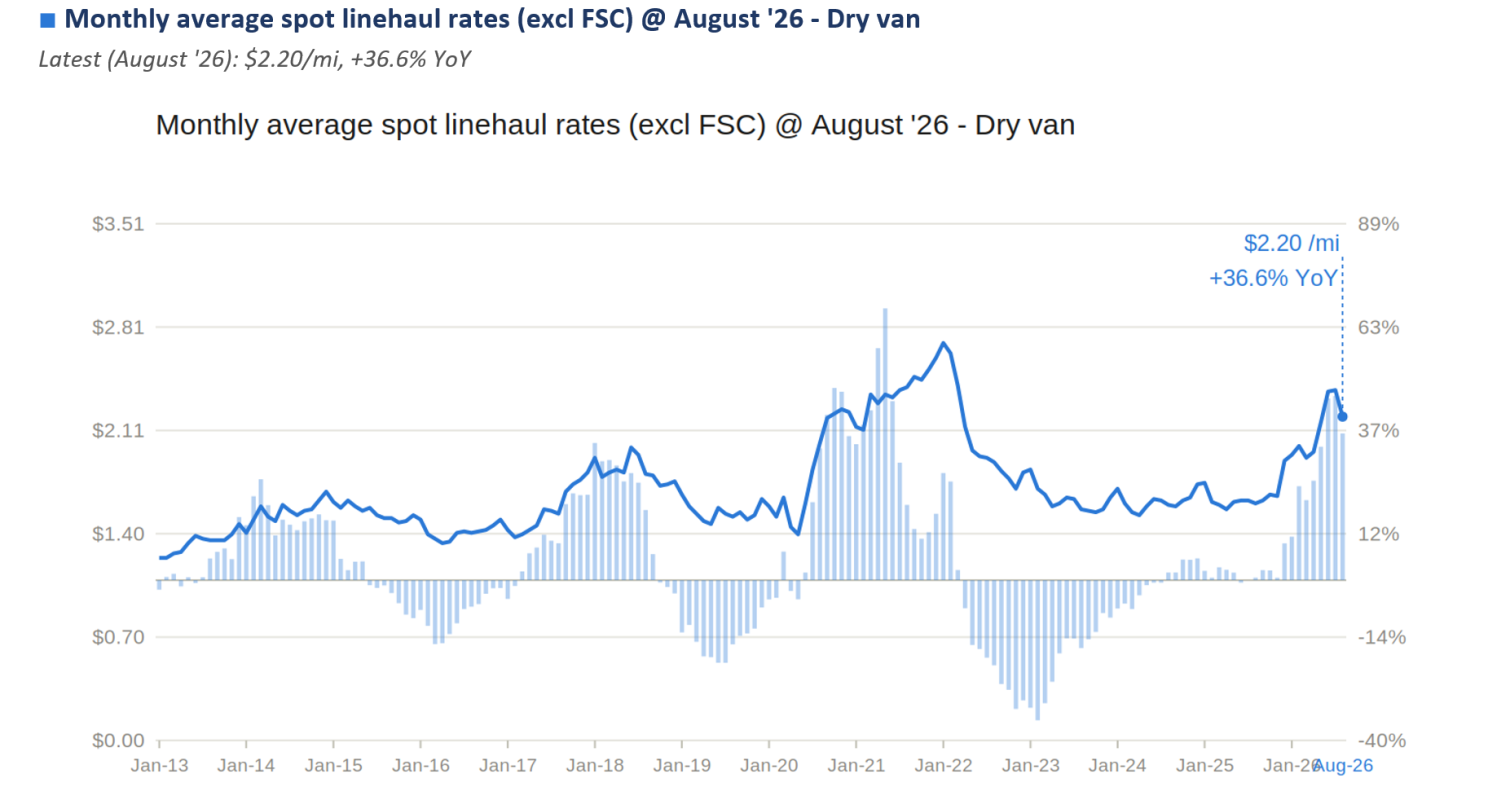
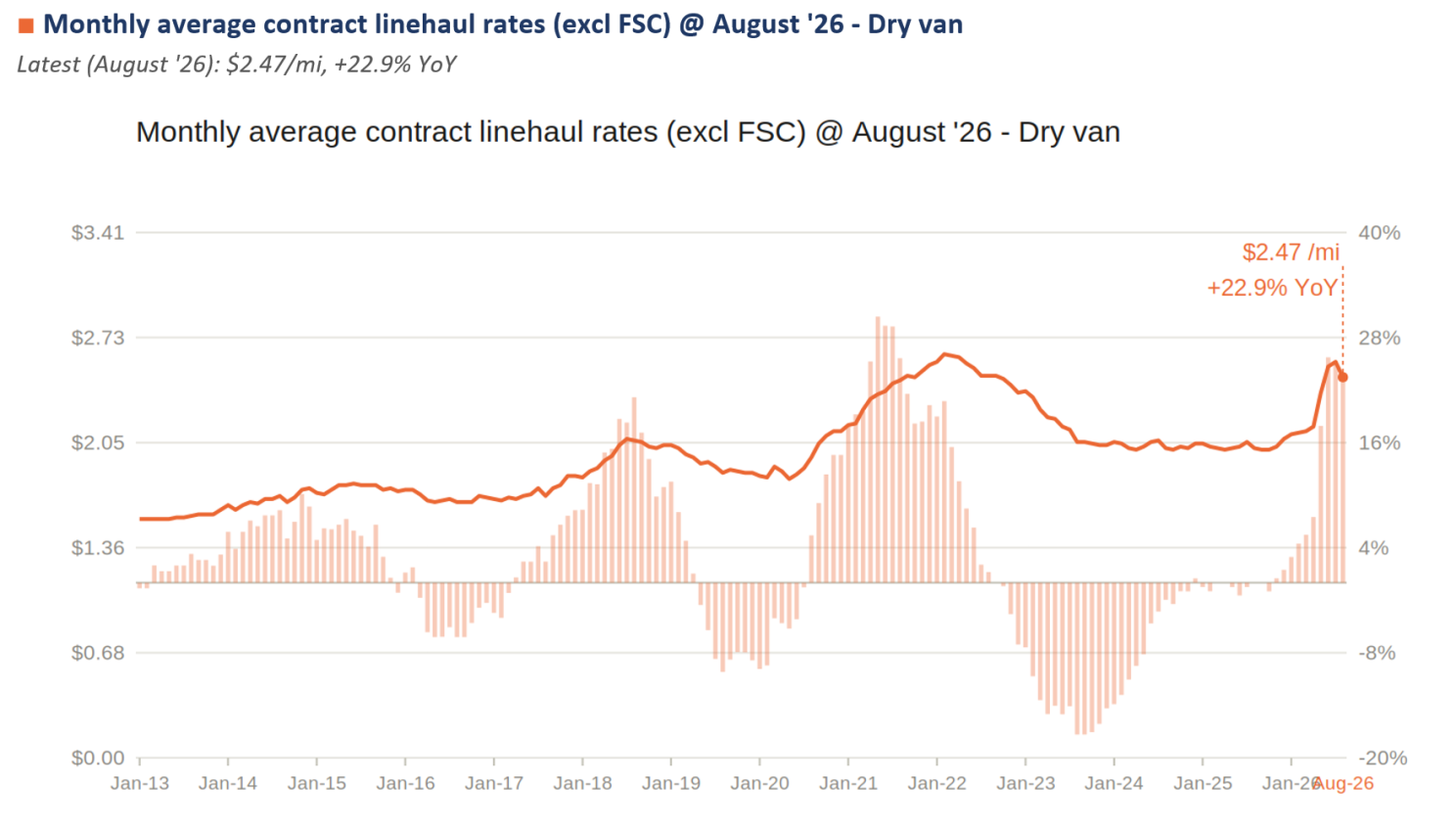
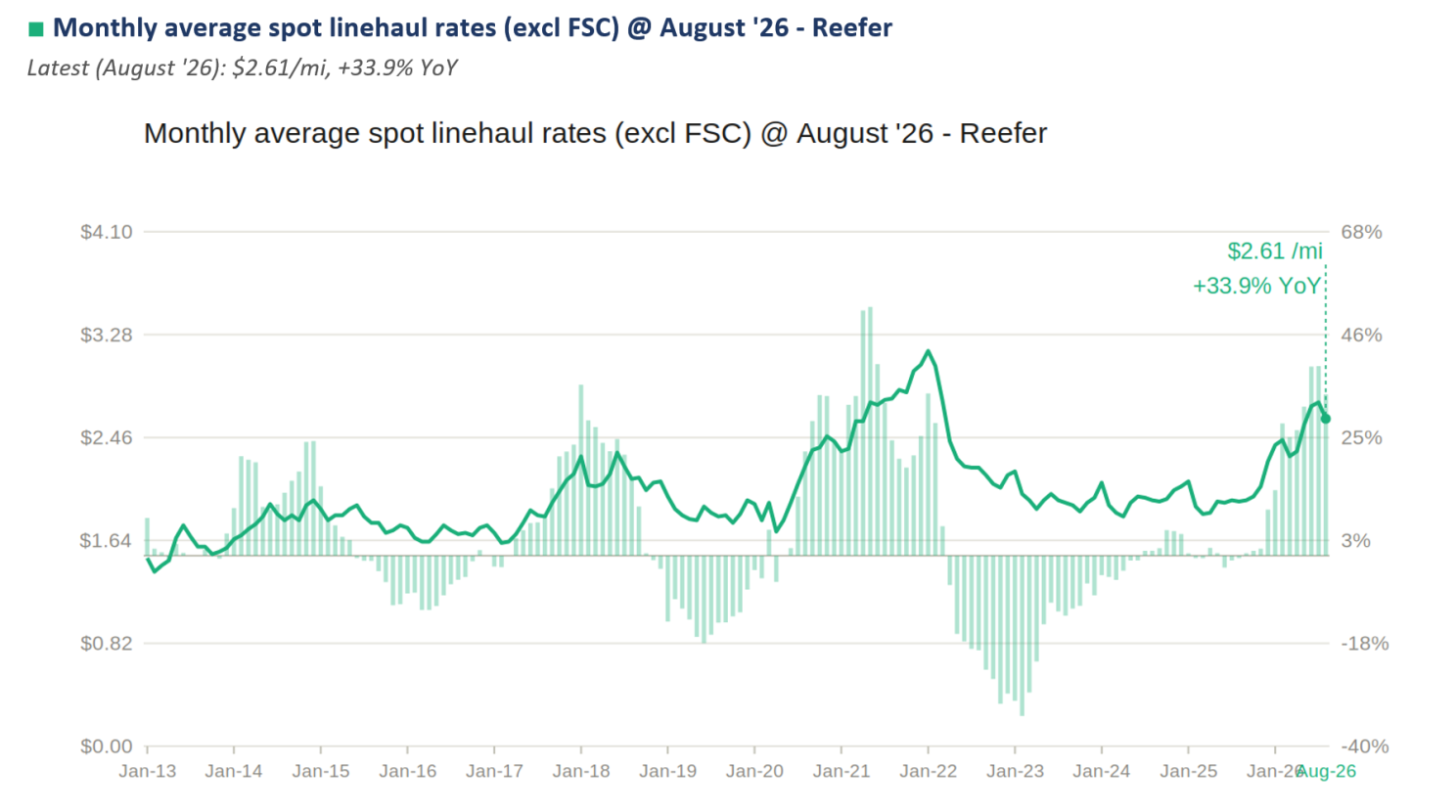
Thank you to Dean Croke at DAT for providing us with this month’s charts and rate summary.
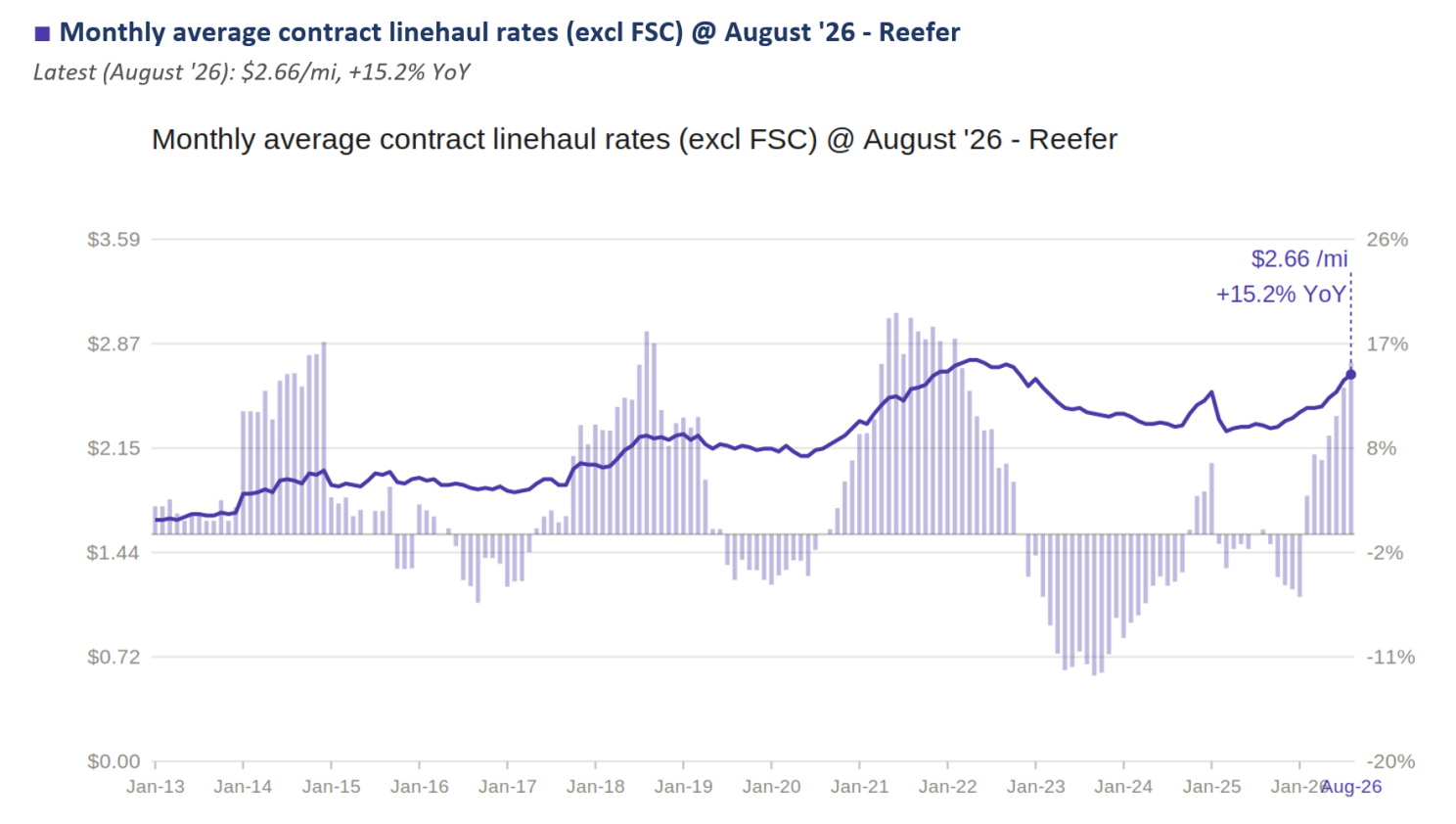
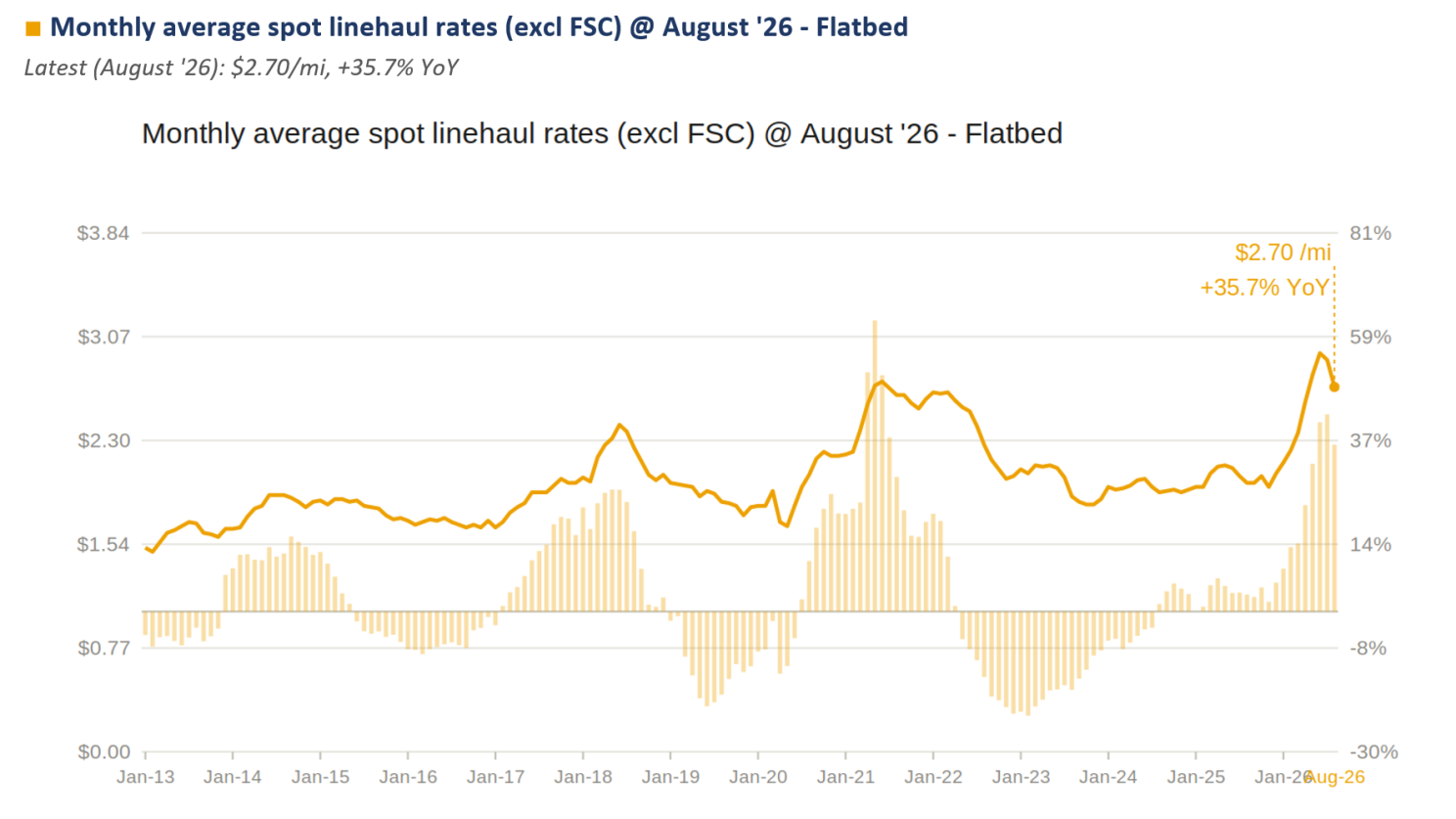
"Spot linehaul rates eased across all three equipment types in August, the typical late-summer softening after the June produce peak: dry van slipped to $2.20/mi, reefer to $2.61, and flatbed to $2.70, each down month-over-month. The large positive year-over-year figures (dry van +36.6%, reefer +33.9%, flatbed +35.7%) look dramatic but mostly reflect a soft August 2025 base near the cyclical trough rather than a current surge.
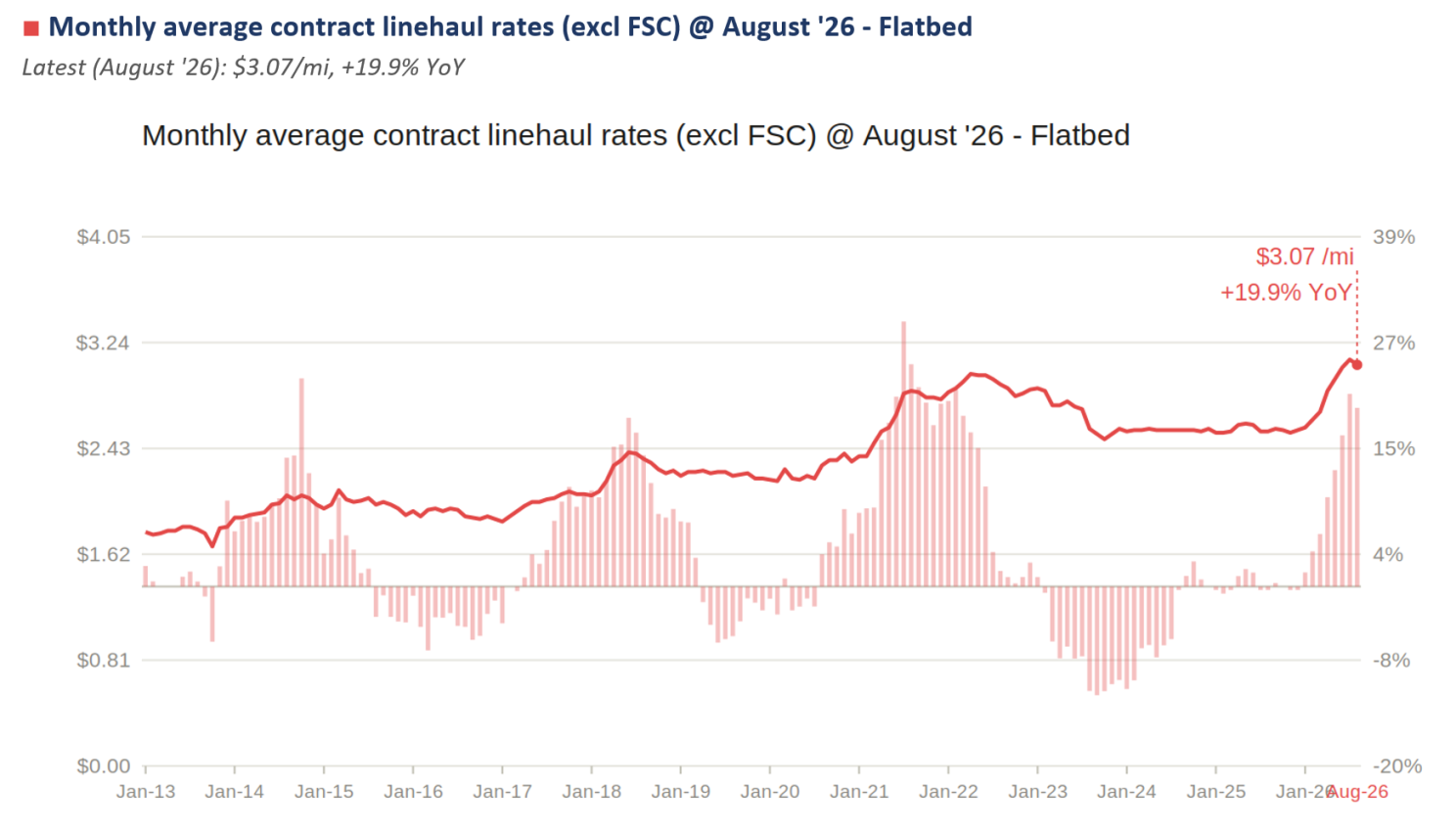
Contract rates were the steadier, more constructive signal, continuing to reprice upward — dry van at $2.47/mi (+22.9%), reefer at $2.66 (+15.2%), and flatbed at $3.07 (+19.9%) — indicating the market is recovering off a 2025 bottom, not running hot."
As we prepare for RFP season it also seems timely to begin thinking about long term 2027 forecasts, and C.H. Robinson recently released their outlook for the 2027 truckload rate environment. The full release is linked here, but here is a snippet:
Looking ahead, C.H. Robinson forecasts the cost per mile for dry van truckload in 2027 to increase approximately 10% year over year (y/y) compared to 2026. The forecast reflects a market where freight demand remains relatively muted in the near term, but transportation supply continues to contract. As capacity exits the market, costs are expected to increase steadily through 2027, even without a significant change in underlying freight demand. The largest y/y increases are expected during the first half of 2027, driven primarily by softer comparables against early 2026 market conditions and anticipated tightening around seasonal capacity events. Growth is expected to moderate later in the year as the market moves further into the peak phase of the freight cycle. While economic uncertainty remains a key variable, the current outlook assumes that the contraction of trucking supply will continue to outpace freight growth, resulting in a gradually firmer pricing environment through 2027.
It seems supply contraction will continue on. Which makes sourcing reliable capacity all the more important, and brings me to my thank you to this month's newsletter sponsor! Thank you to Atlantic Cargo for supporting the work we do here to keep industry participants informed.
Atlantic Cargo is a 200 truck dry van fleet based out of West Chester, Ohio with a second terminal in Orlando, FL. They operate over 100 of their trucks with team drivers, and set themselves apart by carrying $500k cargo coverage on all their loads. They specialize in transporting goods that are highly exposed to cargo theft, including consumer electronics, data center infrastructure, ecommerce merchandise, and other consumer goods and manufacturing materials. Have questions? Contact them here.

Meet Me For Coffee with Samantha Jones seeks to correlate macro-economics to freight markets (just like this Newsletter does) and offers a chance to hear various industry and non-industry experts explain their thoughts on economics and freight markets.
Check out our Podcast Channels on your preferred platforms!

If you attend no other supply chain conference all year, you must at least attend Manifest Vegas . I have been partnered with Manifest for the last 3 years and I cannot encourage you strongly enough to ATTEND THIS CONFERENCE. There is truly something for everyone. Yes, I know February 2027 is still a long ways off, but it comes up quick! And, if you know you have to attend, you might as well take advantage of early bird rates while you still can! Get the cheapest tickets possible now, and an ADDITIONAL $200 off with my unique link! Details and discount here: http://manifestvegas.com/MeetMeForCoffee

Thank you so much for reading and supporting the Truckload Market Update Report, produced by Samantha Jones Consulting LLC. Samantha Jones Consulting focuses on helping companies in the logistics industry better brand and sell their services to create sustainable revenue growth, and support their company growth goals!
We love Feedback, if you have questions, comments, suggestions, or are interested in sponsorships or partnerships, please email samantha@connectsjc.com to connect!
Make sure you subscribe to the Newsletter to receive the monthly update, and please share this with a friend who can also benefit from reading! As always, Samantha's work is free and created with the intent to add value to the transportation industry.
