

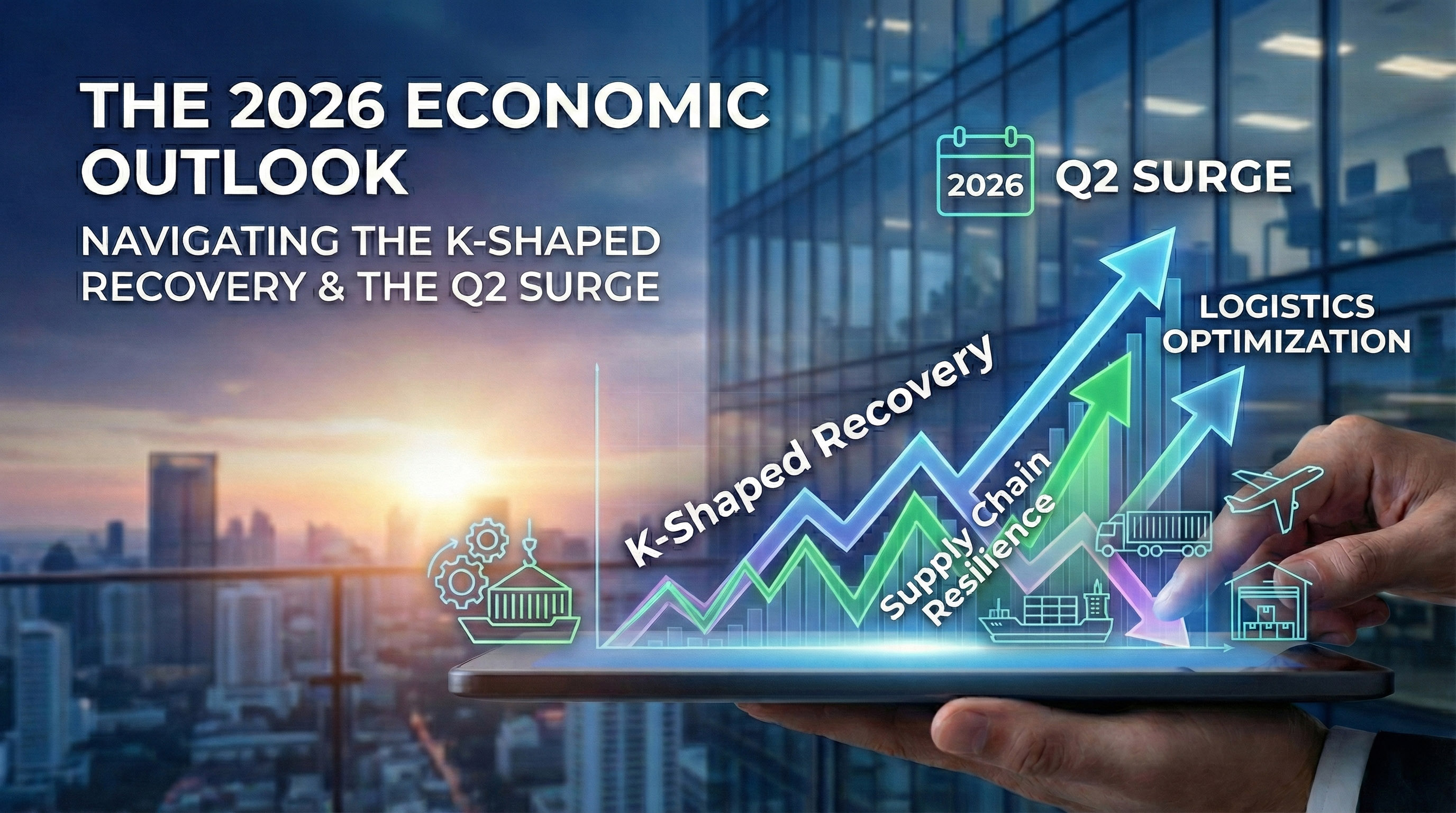
As supply chain and logistics professionals look toward 2026, the economic horizon is a story of two distinct halves. While the beginning of the year may feel sluggish, leading indicators suggest a shift is coming. According to recent insights from Samantha Jones and Keith Prather, Managing Director of Armada Corporate Intelligence, the industry should prepare for a significant pivot in the second quarter.
Prather, who specializes in corporate intelligence and economic modeling, suggests that while Q1 might remain flat, Q2 is forecasted to bring a surge in activity that could lift the freight economy through the end of the year. However, capitalizing on this growth requires understanding the complex "K-shaped" recovery currently defining the U.S. market.
Unlike a standard recession, where the economy recovers uniformly, the current landscape is divided. Prather explains that for the last several years, the upper arm of the "K"—households earning over $100,000—has driven nearly all economic growth. Meanwhile, the lower end of the "K"—households earning under $75,000—has struggled to keep up with inflation.
"The upper end of the K is where all of our growth has been for the last four years," Prather notes. "That's what's been driving the freight volumes... retail spending... automotive."
However, a shift in sentiment is emerging. High-income earners are becoming nervous, leading to "down-branding," in which consumers migrate from high-end retailers to value-driven brands. For the economy to thrive in 2026, the administration faces a delicate balancing act: taming inflation to activate lower-income brackets without spooking high-income spenders who have kept the economy afloat.
Despite the headwinds, specific drivers are lined up to stimulate demand mid-year. One major factor is the housing market. If the Federal Reserve continues to trim rates and the 10-year Treasury yield follows, mortgage rates could stabilize, unlocking pent-up demand.
The logistics impact of housing cannot be overstated. As Prather points out, "For every single new home we build, [it] creates about seven full truckloads of demand." Activating the housing market could be the catalyst needed to push the industry out of the prolonged transportation recession.
Additionally, industrial construction is poised for a boost due to tax provisions. Companies looking to utilize 100% bonus depreciation on projects must have them completed by the end of 2030. To meet that deadline, Prather advises that "shovels and dirt" must move in 2026 and 2027, creating a natural timeline for increased industrial freight volume.
A unique element of the current economic sentiment is the fear surrounding Artificial Intelligence (AI) and white-collar job security. Unlike in previous cycles, when labor weakness was felt primarily in hourly sectors, current layoffs are hitting business and professional services.
Jones highlighted that many professionals who enjoyed promotions and wage increases during the post-pandemic boom are now facing uncertainty. "For the first time, we have a technology that's kind of hitting and aiming at those white-collar six-figure jobs," Prather observes. This anxiety contributes to the upper-income bracket's hesitation to spend, creating a psychological headwind against growth.
The conversation around inflation has shifted from general consumer goods to the service sector and the lingering effects of tariffs. While many foreign manufacturers initially discounted prices to offset tariffs, those margins are drying up, which could delay inflationary pressure in 2026.
Prather warns that the bond market is closely watching these dynamics. The 10-year Treasury yield—critical for mortgage rates and corporate borrowing—reacts negatively to deficits. If the government reduces tariffs or offers significant consumer rebates that increase the deficit, bond yields could spike, choking off the very housing recovery the market needs.
As Jones notes, we are entering a period of high complexity regarding trade deals, particularly with the USMCA review on the horizon. "We're going to build uncertainty as we get closer to the USMCA negotiations," Prather agrees. However, he suggests that behind-the-scenes negotiations may be going smoother than the public "storming" phase suggests.
The roadmap for 2026 is one of cautious optimism tempered by structural risks. If inflation remains tame and the industrial and housing sectors activate as predicted, the sluggish start to the year could give way to a robust second half. For transportation leaders, the key will be surviving the flat Q1 while positioning assets to handle the anticipated volume surge in Q2.


This month's newsletter explores the "K-shaped" US economy: a booming, AI-driven stock market for asset owners contrasted with the everyday squeeze of rising living costs for average households. We break down the latest data on wages, inflation, inventory-to-sales ratios, the Fed's September meeting, and truckload rates. Read on and share your insights in the comments!
Read MoreThis month's Newsletter is a written format of the Meet Me For Coffee Podcast Panel. If you need strong sources to cite in your planning and research these days, I'd highly recommend giving this a read!
Read MoreThe June Truckload Market Update is out. It covers corporate earnings and profits, consumer spending, inflation, wages, manufacturing, and truckload rate environments.
Read More